
The Boy Behind the Wardrobe - Perfect Picture Book Friday #PPBF
This is a great picture book biography connecting the influences, struggles, and friendships of a young boy called Jack which led to C.S. Lewis's creation of one of the most beloved series of children's books - Narnia.

The Boy Behind the Wardrobe: How C.S. Lewis Grew Up to Create Narnia
Author: Suzanne Poulter Harris
Illustrator: Mira Miroslavova
Publisher: Eerdmans Books for Young Readers (October 20, 2026)
Ages: 6 - 12
Nonfiction Biography
Themes:
Imagination, bullying, friendship, biography, and the magic of books.
Synopsis:
A lonely, imaginative boy becomes the world-renowned author of The Chronicles of Narnia in this spellbinding biography of C.S. Lewis.
Once a boy was born to make stories: C.S. Lewis. He insisted on being called “Jack” and loved to write and draw with his older brother. But after his mother died, he was shipped to boarding school, where he longed for real friends and sought refuge in books. And words and stories would strengthen him during World War I, connect him to bookish friends like J.R.R. Tolkien, and drive him toward his destiny as a world-renowned author…
With lyrical words from Suzanne Poulter Harris and lush, fantastical art from Mira Miroslavova, The Boy Behind the Wardrobe goes beyond the traditional picture book biography to explore the history and emotional trajectory of a child who struggled to fit in, yet created books beloved by millions around the globe. Like the wardrobe transporting the Pevensies to Narnia, this biography will transport readers into Lewis’s solitary childhood, his fantastic imagination, and his journey of hope. An author’s note, timeline, bibliography, and other back matter offer additional insights into Jack’s life and inspiration.
The Boy Behind the Wardrobe is Suzanne Poulter Harris’s debut picture book, shaped by the echoes of Narnia that she found in her homeland of Northern Ireland.
Opening Lines:
In the days when Belfast made mighty ships,
a boy was born to make stories.
His parents called him Clive Staples Lewis.
He just called himself "Jacksie."
And just like that the boy became Jack.
What I LOVED about this book: After opening with a smoky, grey scene of the Belfast harbor, we get a wonderful introduction to Jack and his brother, Warnie, and their collaborative creation of adventures that were fed by the poetry, play, novels, fairytales, and myths they were exposed to by their parents and nursemaid. I love how the sun coming through the darkened room illuminates and highlights their imaginative world.

Text © Suzanne Poulter Harris, 2026. Image © Mira Miroslavova, 2026.
Mira Miroslavova's digital illustrations are both realistic and fantastical, sometimes within the same image. For instance, when the brothers are watching Belfast and exploring the hills on their bikes, we get this stunning swirl of activity .

Text © Suzanne Poulter Harris, 2026. Image © Mira Miroslavova, 2026.
Primarily portrayed in a deep, earth-toned palette of browns, blues, and greys, the occasional light backgrounds, sparkles, or floating or wispy outlined characters really stand out, both lightening the mood and highlighting the magic of Jack's imagination.
Left to his own devices in the afternoons, after Warne was sent to boarding school, Jack discovered companions in books and in his own stories. Especially the brave, animal knights he created in Animal-Land, or Boxen, which he shared and expanded with Warne during school vacations.
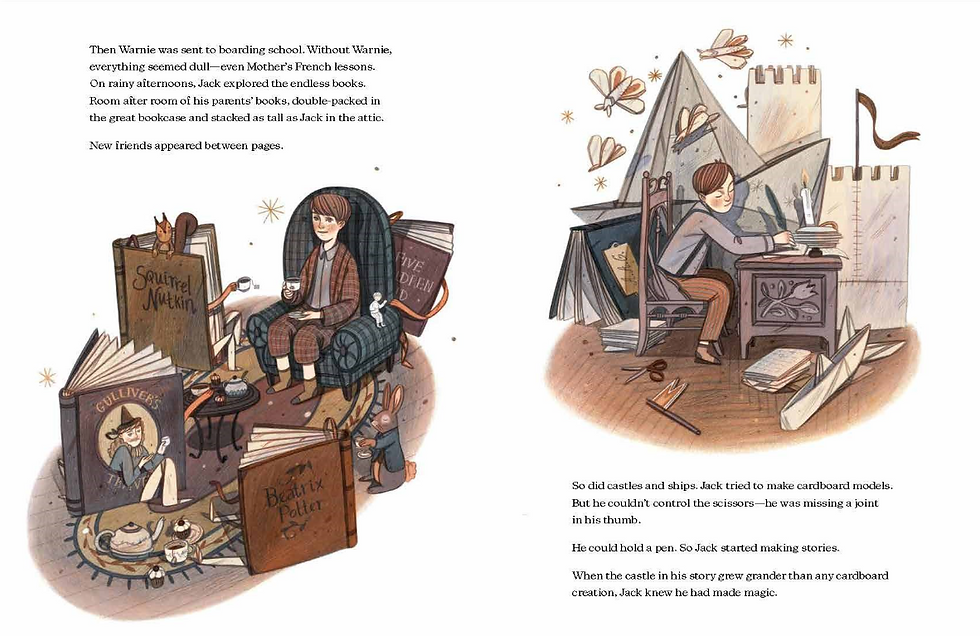
Text © Suzanne Poulter Harris, 2026. Image © Mira Miroslavova, 2026.
Leading the reader through Jack's various experiences from his grandfather's lion head knocker, hiding in a cupboard with cousins (a stunning illustration in Suzanne Poulter Harris's interview on Monday), his mother's death, boarding school bullies, WWI, and life as a student and teacher at Oxford, the book highlights the effects these all had on his writing. While depicted seriously, the text and illustrations neither sensationalize nor gloss over Jack's emotions and struggles at these moments. "Jack reached the cold, damp trenches of northern France. Writing poetry eased those dark days. And later, books helped heal the cries and wounds of the battlefields." In the accompanying image, Jack is depicted, standing in a very somber barb-wired trench facing other soldiers holding a handful of papers.
The book spends a little more time on Jack's discovery of fellow writers, their creation of the group "The Inklings," and a special friend nicknamed "Tollers." If you are ever in Oxford, the pub where the group held their meetings, The Eagle and the Child, still exists and still has an aura of magic and inspiration to it.

Text © Suzanne Poulter Harris, 2026. Image © Mira Miroslavova, 2026.
With a bit of humor and whimsy, the text and illustrations explore C.S. Lewis's continued connection to Jack (his inner child self) and his impetus to create a fairytale for children displaced by WWII by combining "ancient myths with the make-believe of his childhood." An author's note and illustrator note relay their connections to The Chronicles of Narnia and Northern Ireland as well as providing some additional information on C.S. Lewis. This is a sensitive and stunning biography of the creator of the magical and enchanting Narnia books.
Resources:
if you could step through a magical door or wardrobe, what adventure would you have? Write or draw your story.
pair this with Through the Wardrobe: How C. S. Lewis Created Narnia by Lina Maslo and Finding Narnia: The Story of C.S. Lewis and His Brother by Caroline McAlister, illustrated by Jessica Lanan. How are the books the same and how do they differ? What choices did the authors make in their approach to writing about C.S. Lewis's life and writing?
If you missed my interview with Suzanne Poulter Harris on Monday, find it (here).
This post is part of a series of blog posts by authors and KidLit bloggers called Perfect Picture Book Fridays. For more picture book suggestions and resources see Susanna Leonard Hill's Perfect Picture Books.


Comments