
The Picture Book Buzz - Interview w/Maria Gianferrari, Maris Wicks, Review of Puffins! + Giveaway
Maria Gianferrari is a community scientist, self-taught naturalist, and bird nerd who holds an M.A. in Creative Writing and a Ph.D. in English.
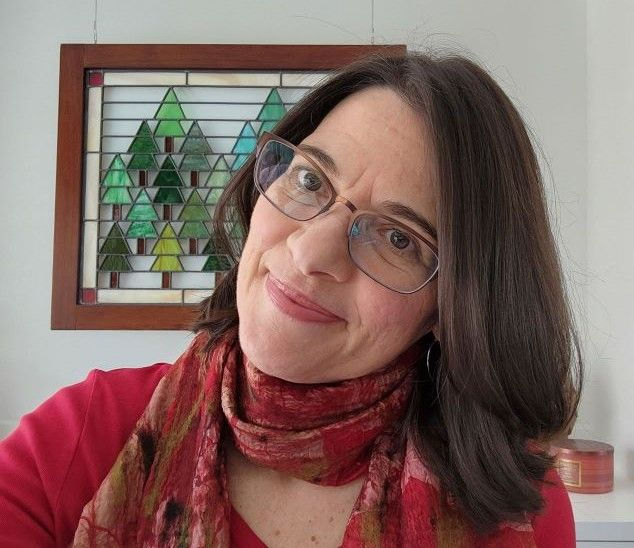
She is the author of narrative and expository nonfiction picture books which celebrate urban ecosystems, the natural world, and our wild neighbors. Maria lives in Massachusetts in a house encircled by trees where all kinds of birds, coyotes, bobcats, and the occasional bear wander through.

Maria’s the author of 22 books, including Rain and the Reading Horse, illustrated by Hannah Salyer (2025), To Dogs, with Love, illustrated by Isha Lobo (2023); Fungi Grow, illustrated by Diana Sudyka (2023), Thank a Farmer, illustrated by Monica Mikai (2023), You and the Bowerbird, illustrated by Maris Wicks (2023), and the companion books Being a Cat (2023), and Being a Dog (2022), both illustrated by Pete Oswald.
Maris Wicks is a writer and illustrator whose work has taken her all over the world, from the warm waters of the Caribbean to the frozen ice of Antarctica.

Most recently, she got to hang out with all the incredible seabirds on Eastern Egg Rock, and she is not exaggerating about the amount of poop.
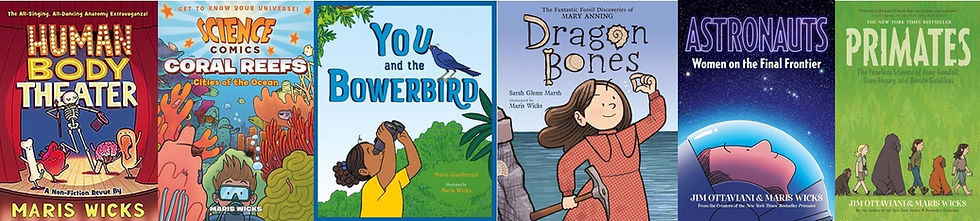
Maris is the author/illustrator of Human Body Theater: A Non-Fiction Revue by Maris Wicks (2015) and Science Comics: Coral Reefs (2016). She’s also the illustrator of over 33 books and comics, including You and the Bowerbird by Maria Gianferrari (2023), Dragon Bones: The Fantastic Fossil Discoveries of Mary Anning by Sarah Glenn Marsh (2022), and Astronauts: Women on the Final Frontier (2020) and Primates: The Fearless Science of Jane Goodall, Dian Fossey and Birute Galdikas (2013), both by Jim Ottaviani.
Their newest picture book collaboration, Puffins! April 14th.
Welcome Maria and Maris, thank you so much for stopping back by to talk about your new book!
Thanks for letting us share Puffins!, Maria!
Hi! Hello! Thanks for having us!
Maris let’s start with you. Tell us a little about yourself. (Where/when do you write and illustrate? How long have you been writing and illustrating? What is your favorite type of book to write and illustrate?)
MARIS - So right now, I'm doing all my work in my favourite place: the middle of the woods! I recently moved to Cape Breton in Nova Scotia, Canada. I had lived in cities (Providence, RI, and then Boston, MA) for over 20 years, and as much as I loved city life, I really missed the forest. Nature has long been a huge inspiration for me, and I know you can find nature EVERYWHERE (hello, my pigeon friends in the city), but I'm really enjoying getting to know my new habitat.
I've been drawing since I can remember, and I like to draw A LOT. Sometimes it would get me in trouble (like drawing in a class that was not art class). But by the time I got to high school, I realized that drawing and doodling in my notes actually helped me learn (and most of my teachers were cool about it, especially my science teachers). I liked drawing so much that I decided I should go to college for it! I graduated from RISD (Rhode Island School of Design) with a B.F.A. in Illustration (illustration = using art to tell stories). One of the classes I took was Comic Book Narrative, Storytelling and Illustration (taught by David Mazzucchelli) and it changed my life. It was like a big, cartoony lightbulb went off above my head; DING! DING! DING! I want to MAKE COMICS!
Doing any type of art (writing, theatre, dance, music, visual art) as a full-time job can be very challenging, for lots of reasons, so I spent most of my time working other jobs. Those included (but are limited to): dishwasher, sandwich maker, emergency medical technician, camp counsellor, cashier, farm worker, sign painter, baker, apple orchard tour guide, children's museum educator, art teacher, and ocean science educator. I started making mini-comics (little self-published comics) at the end of college and started going to small comics shows. Eventually, I started tabling at comics shows, selling my work, and meeting more people in the comics community. I got my first comics illustration job with the book Primates, written by Jim Ottaviani, published by First Second Books. Jim later convinced me to try writing my own comics stories (thank you, Jim). I like to split my time between making solo work and collaborating with writers (like Maria!)
My favourite type of book to illustrate is anything about animals! Perhaps a bit broader would be anything to do with biology and ecology. I've loved animals since I was a kid! Observing any and all types of critters and thinking about what their lives are like is something I will NEVER get tired of! This applies to humans as well; we are also animals
It is wonderful to "meet" you Maris! What is one of the most fun or unusual places where you’ve written or illustrated a manuscript?
MARIS – Hah! I love this question! One of the amazing things about my work is that I often get to tag along with scientists in the field, so I can get a real sense of what it takes for them to do their job. I have done research, writing, and drawing for my books while...SCUBA diving in the Caribbean, cutting deep-sea rocks in half with a chop saw on a research ship in the middle of the Atlantic ocean, on the side of an active volcano in Antarctica, and most recently, working off the coast of Maine with the scientists and support teams on Eastern Egg Rock, studying sea birds (including Atlantic puffins)!
That sounds exciting and so amazing. What a great career! Was there a difference in the way you collaborated on this book versus your earlier book You and the Bowerbird?

MARIA - We definitely had a lot more back and forth during the revision process, since we already knew each other and had previously collaborated. We met on zoom several times to talk about different sections of the book, especially the back matter since that was taking a more direct comics angle and included fact and particulars that Maris had observed during her visit to Eastern Egg Rock (EER). We also had several meetings with our editor extraordinaire, Emily Feinberg, and TeamPuffin at Roaring Brook at various stages of the book’s development to discuss text and art edits which is always a lot of fun.
MARIS – Maria and I knew each other better! Working in picture books, it's often unusual for the writer and illustrator to communicate, but I believe that it's imperative when working on a nonfiction book. There's so much research and resources that Maria has covered and sharing that really helps me to illustrate the most scientifically accurate and authentic story. Plus, I got to have an awesome field trip to Eastern Egg Rock, where the puffins in the book live! I try to take field trips for every book that I work on, even if it's a trip to a museum or zoo/aquarium. But I prefer to go somewhere remote with no running water and live in a tent for a while - I can get a much better understanding of what life is like for the animals that I'm drawing.
Sounds like you two had a great time creating this book. I think we are all better for your collaboration. Maria, what was that the inspiration or spark of interest for Puffins!

MARIA - PUFFINS! I am a bird nerd😊, and they are adorable creatures. I don’t live near the sea, so I don’t know very much about waterfowl. Back in 2016, my husband and I took a trip to coastal Maine. I had always wanted to see puffins, so we took a boat tour around EER—my first impression was that seabirds are LOUD! So much noise and squawking! In fact, my initial working title for the book was Atlantic Puffin City, since I was making comparisons between the puffins and other seabirds who nest there to a raucous city. I was inspired by these silly looking creatures, called sea parrots, or clowns of the sea, and that’s how the book was born.
It seems the puffins and the trip had quite an effect on you. Maris, what about the Puffins! manuscript appealed to you as an illustrator?

MARIS - So many things! What immediately caught me was the location - this is first book I've worked on that took place in a habitat so close to where I grew up! When I was a kid (and teen), my family would go to Maine for vacation. We'd camp along the coast, or one time we even did a sea kayak trip, staying on tiny islands! Later, in my 20s and 30s, I worked at the New England Aquarium, teaching programs about our coast. The rocky intertidal zone of the North Atlantic feels like home to me: the knotted wrack seaweed, with periwinkles nestled in between its slippery strands, barnacle-encrusted granite boulders, and tiny, long-clawed hermit crabs feasting on little bits of leftovers. It was an honour to illustrate a place that was so special to me, and I wanted to do it justice.
I am also a HUGE bird nerd. When it comes to seabirds, penguins are my favourite (Adélie, to be exact, but shhhhh please don't tell the puffins I said that). I actually didn't know that much about Atlantic puffins, so doing the research was fun! And there are so many parallels in the adaptations of both penguins and puffins (the black and white countershading, being more graceful underwater than on land, and of course their very freaky, spiky mouths). The opportunity to not just learn more about our local seabirds, but also to get up close and personal with them was truly a special one.
And last, I was just excited to work with Maria again! I feel like we both get really excited about science and conservation and how to translate those things into a picture book. Her enthusiasm is contagious (and hopefully mine is too)!
It's obvious why this was such a great match to your interests and why you'd be excited to illustrate it. What was the toughest part about writing or illustrating Puffins! And what was the most fun part?
MARIA - This is true of all my nonfiction projects and the pre-writing process. I love research, because I learn so many fascinating things, so that is always a very fun part. I don’t want to leave anything out, so one challenge is what not to include. Luckily I am also a back matter nerd, so the gems that don’t make it to the main manuscript can sparkle there.
On the puffin tour, I learned about how EER was an Atlantic puffin re-wilding success story. Puffins were nearly eliminated from the islands of Maine in the early 1900s due to hunting for food and feathered hats. And now they’re facing the challenges of climate change, since they are a specialist species whose prey is affected by warming waters. Initially I thought I might tell the re-wilding story. But during the revision process I decided that I instead wanted to focus on nesting puffins and share a life cycle story. I love sharing the details about their nesting behavior—it’s a way of making the reader into a birder-observer. In the end, we also covered the EER history in the back matter. I love how Maris made it so lively and engaging in comics form.
MARIS – Toughest part: Keeping up on the current scientific research. While some things will remain consistent (like what Atlantic puffins look like), there's all sorts of research being done about things like their behaviour, or how their populations are being impacted by climate change. Working with the folks at Project Puffins/Seabird Institute was really helpful - and that includes scientists, conservationists, educators and support staff! I think there's always a worry for me about "getting it right" but I do feel like both Maria and I did the best that we can to represent both Atlantic puffins and the science/research behind them to the best of our abilities. Science is a dynamic field, and the information that we have is continuously being updated.
Most fun part: Besides getting to live on the puffin island...really leaning into my cartooning skills to depict their lives! After watching puffins and their many behaviours, I wanted to capture that magic with my drawings. Expressions and body language were key in doing this, and I just really had a blast pushing those visual elements!
Narrowing and keeping current is such a challenge at times with nonfiction, but it is also, as you both mentioned, a big part of the fun. How many revisions did Puffins! take from the first draft to publication?
MARIA - Many! The specific number of drafts is always difficult to calculate. I have so many folders with various stages of the revision, based on additional research, or after getting feedback from critique partners. I did the initial research and writing back in 2017, and then it went out to a few editors, and got rejections. It then sat in my manuscript “graveyard” drawer for many years. After working with Maris and discovering just how much she loves birds, especially penguins, I knew she’d be perfect for it! I revived and revised it to emphasize the graphic elements. After Emily acquired it and Maris happily agreed to illustrate it, it then went through more rounds of revisions. We also wanted to ensure that the puffin science was accurate, so we made the relevant changes after it was reviewed by some folks at Project Puffin/Seabird Institute.
Here’s a visual revision representation—it’s like an infinite house of mirrors: one folder, leads to another, and another, and so on . . .

© Maria Gianferrari
MARIS – Hmmm. I can really only speak for the art side. My process is: research (including sketches) ---> first pass (dummy/roughs) ---> line art ---> colours (with edits in between each stage). I do pretty detailed thumbnails/sketches for the first pass; looking at my files I think I've got 2 versions for the dummy/roughs, 2 versions for the line art, and 3-4 versions of the final art (usually catching/changing very small stuff). I don't think there were any major changes to the manuscript/text from sketch to final art.
I love the comparison to a house of mirrors and your breakdown of the illustration process. Thank you both for providing that. Maris, many illustrators leave treasures or weave their own story (or elements) throughout the illustrations. Did you do this in Puffins! If so, could you share one or more with us?
MARIS – Focusing on the whole ecosystem (and not purely on the puffins) was important to me, so I packed the scenes with native plants, seaweeds, LOTS of invertebrates (lol I have an agenda and it consists of snails, sea slugs, crabs, shrimp, clams, mussels, tunicates, barnacles, etc.), and plenty of other animals (many types of birds and fish, a bonus harbor seal). Even researching the geology and types of rocks (lots of granite) that the island is made of! These details are essential, and speak to the practice of observation, which is an important skill for artists and scientists alike! Plus, I am a big Where's Waldo fan, and I really like making illustrations that invite you to stay and look around for a while (like the cover to Puffins!).
Also: the poop. I mean, Maria gave me permission right out the gate when she mentioned "guano-frosted" rocks in the manuscript! And seabirds, well...they poop A LOT! It's just part of nature, but I'm glad that our editors didn't ask me to "turn it down," even with one of the puffins on the cover pooping, even with the TITLE of the book being covered in poop. I got to be my full silly, passionate self for this book, and I feel like that was a treasure in and of itself.
Oh my gosh!😂 I can just imagine the fun you will both have at school and library visits getting kids to "spot the poop" and see what other facets of the island life they notice. I wonder who sees the poop on the tents and roofs first - kids or caregivers? Maria, when you first saw Maris’s illustrations in Puffins!, did anything surprise, amaze, or delight you? Which is your favorite spread or one you particularly enjoy?
MARIA – I wasn’t surprised in the sense that I knew that whatever Maris created would be amazing, but I am continually surprised by the details—there is so much joy and wonder and delight infused in all of Maris’s spreads that Maris! I am in love with each and every puffin!
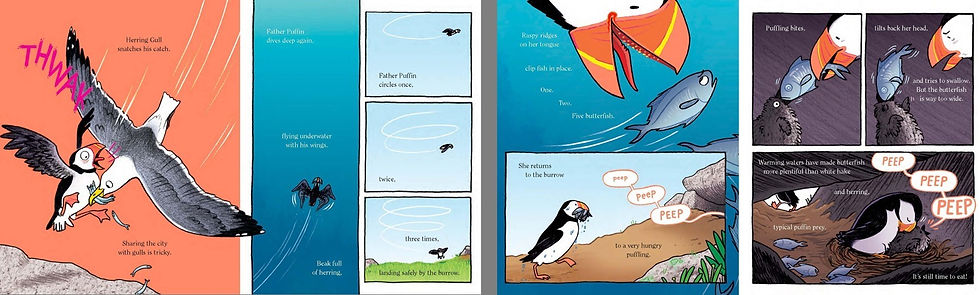
One thing that stunned me was the neon orange. In the PDF proofs it was not nearly as bright. Once I received my author copies I was absolutely WOW-ed and thrilled.
Text © Maria Gianferrari, 2026. Image © Maris Wicks, 2026.
Here are a couple of examples (and again, this version is quite dull compared to the real life orange in the book. Imagine a traffic cone—that’s how bright! So vibrant and fun! And such a nice cheery contrast with the soothing shades of cerulean blue.

Text © Maria Gianferrari, 2026. Image © Maris Wicks, 2026.
Perhaps the truest surprise was the actual book cover. It’s brilliant: slip off the jacket and a life-size puffin appears! Another adorable detail—on the back cover is an image of a parent puffin reading our Puffins! to their puffling! Maris also had a surprise cover for You and the Bowerbird—she is so clever and creative!

Text © Maria Gianferrari, 2026. Image © Maris Wicks, 2026.
I am in absolute awe of this spread—Little Puffin standing on a precipice, about to fledge and plop-drop into the ocean for the very first time. Maris skillfully conveys so much emotion here—it is tender and scary and exciting and just plain beautiful. The previous page is humorous, as Little Puffin climbs guano-frosted rocks, and slides down beards of seaweeds, but humor also needs to have heart, and Maris delivers. I love the movement of the waves, the star-filled sky, the light of the moon reflecting in the water—it takes my breath away.
Thank you for sharing all of these special spreads and insights. The book cover is amazing! And this wordless moment of the puffling looking out at the ocean's expanse is stunning. I can see why it is one of your favorites. Maris, is there a spread that you were especially excited about or proud of? Or perhaps one which is your favorite spread in Puffins!
MARIS – Ahhhhhhh the nighttime scene/spread!!! I went full-nerd and tried my best to make sure that the stars where in the correct place for that spread (I used astrophotography pics for reference). The theme of that scene though - leaving the comfort of your home for the first time, all on your own - I wanted it to be both scary and exciting! I think capturing these moments and these feelings gets us to empathize with animals. But it also gets us to reflect on those events in our human lives: going to school for the first time, or going to a new school, graduating, and general big life changes. There are lots of ways to foster connections to nature!
It's awesome to learn that you went full stellar nerd! You did a spectacular job capturing this moment of striking out on one's own - whether Puffin or human. It's truly stunning. Are there any projects you are working on now that you can share a tidbit with us?
MARIA – I loved Zoë Schlanger’s The Light Eaters—such an awe-inspiring book! I’ve always loved plants and have a green thumb, but now I’m even more obsessed with them and very slowly working on a poetry plant picture book. Here’s a view of some of the plants by our kitchen window:

© Maria Gianferrari,
MARIS – I have been working on a massive (430-page) graphic novel about my experiences working in Antarctica, in and around McMurdo (the largest research station on the continent). There's a whole lot of science, and a whole lot of me being like that young puffin: being a little scared and a lot excited about learning about what life is like on one of the most remote places on Earth. Also, There Will Be Penguins. The book will probably be out in a few years.
Exciting! We'll have to keep our eyes open for your projects. Good luck with them. Is there something you want your readers to know about, or take away from, Puffins!
MARIA - I love the way Maris’s art brings out the joy and humor as we observe this very hungry little puffling. It’s a book that celebrates an Atlantic Puffin family in a real place, EER in Maine, and showcases the challenges they face from warming sea waters and overfishing that make their prey less available, to the threat of aerial predators, as their very hungry puffling grows, and eventually fledges. And it’s truly an amazing feat of parenting that they are successful despite it all. Remember—they lay only one egg during the entire season—that’s it. So, there is a lot riding on their success. EER is a science conservation success story, and the more we learn about puffins and other seabirds, the more we can help.

Text © Maria Gianferrari, 2026. Image © Maris Wicks, 2026.
Another fun thing: Puffins! is also available as an audio book, with lively narration by voice actor, Tim Campbell. You can hear a sample here on the activities page of my website: https://mariagianferrari.com/activities-resources/
MARIS – Like all the books I've ever worked on, my hope is that Puffins! inspires readers to seek out more information: it could be about puffins, or field science, or poop, or even just learning more about their own local habitats and ecosystems. Even better, if it inspires them to draw or write or get out in nature!
I think you both have succeeded in creating an engaging and inspiring book. Last question, what animal or natural feature (place) do you want to learn more about? Why?
MARIA - I am very excited to be visiting Atlantic puffin territory in September: Newfoundland! The puffin chicks brought to re-establish the EER population originally came from Newfoundland. By the time we visit, most of the puffins will have returned to sea, but I’m hoping to see a few floating about. I can’t wait to experience and learn more about this gorgeous coastal habitat in person.
And I’ll also be visiting Nova Scotia where I will get to hang out with Maris too!
MARIS – I have a hard time picking one thing...the general field of animal intelligence/cognition is deeply fascinating to me. Figuring out how animals communicate, how they live, adapt, even interact with people...I could rabbit-hole on the topic forever. The other area I'd love to explore is invertebrate life! Invertebrates (aka our non-backbone-having animal friends) are often overlooked in favour of more charismatic megafauna. I like to look out for the little guys, so further exploring the wonderful biodiversity of the invertebrate word would be such a joy.
Thank you, Maria and Maris, it was wonderful to chat with you both.
Thank YOU, my fellow Maria!!
To find out more about Maria Gianferrari, or contact her:
Website: https://mariagianferrari.com/
Penny & Jelly Website: http://www.pennyandjelly.com/
To find out more about Maris Wicks, or contact her:
Website: https://www.mariswicks.com/
Instagram: https://www.instagram.com/mariswicks
Review of Puffins!
I have to admit; I have adored Maria Gianferrari's books since I read Bobcat Prowling. And this captivating nonfiction on Atlantic Puffins is no exception. It's an exciting, active look at the life-cycle of the puffins, their predators, and environmental stresses and the efforts of scientists to repopulate Easter Egg Rock off the Coast of Maine with the Atlantic Puffin. Kids will adore the melding of the comic illustration style with the succinct and engaging nonfiction facts and text.
Puffins!
Author: Maria Gianferrari
Illustrator: Maris Wicks
Publisher: Roaring Brook Press (April 14, 2026)
Ages: 4 - 8
Nonfiction
Themes:
Atlantic puffin, life-cycle, marine birds, conservation, and environment.
Synopsis:
Follow a young puffling's life from hatching to adulthood and learn about the bustling and precarious world of Atlantic Puffin City in this imaginative nonfiction picture book.
On the edge of the sea,
There is a nesting island as loud as a city,
Where two puffins mate, burrow, and lay their egg.
They splash into the ocean
And dodge nearby predators,
Searching everywhere to find food for their hungry puffling.
Follow one adorable puffling as she eats, grows, and learns how to survive on her busy, bustling island in this thrilling and action-packed nonfiction tale.
Opening Lines:
This island of puffins
and summering
seabirds
(plus a handful of scientists)
is as noisy as a city.
A nesting city,
safe from land predators.
What I LOVED about this book:
Okay, Maris' comments above about being given free rein to play with poop in the illustrations, it is a bird colony after all, makes one see these white dripping rocks in a whole new light. Most of us have encountered a crying seagull or two, imagine an entire island filled with calling birds. I adore the "catalogue" of the diversity of birds and their vocalizations found on Easter Egg Island, and the analogy of it being "noisy as a city." Pause a moment and look at the bird's calls and you have the "beeps," "honks," "sirens," and sounds of our own cities.

Text © Maria Gianferrari, 2026. Image © Maris Wicks, 2026.
From the moment the adult puffins perform their greeting to their puffling's fledging, the life-cycle of the Atlantic Puffin is engagingly presented in wonderfully succinct text and fun comic-formatted illustrations. I love the variety that Maris Wicks used in her pencil drawn and digitally colored illustrations. Smoothly shifting from the expansive, colorful island scene to the ocean, den, and orange "danger scene" where the gull steals father puffin's fish. Great onomatopoeia and increasingly insistent "peeping" of the puffling interject sound, urgency, and danger into the narrative.
Text © Maria Gianferrari, 2026. Image © Maris Wicks, 2026.
Maria Gianferrari and Maris Wicks gorgeously and intriguingly portray the changes within the egg, hatching, and as the puffling grows and molts. As well as the challenges - from other trespassing puffins, changes in their food supply with warming ocean waters, and marauding Herring Gulls and Great Black-Backed Gulls (who commandeer fish and snatch unprotected young).
The text playfully uses additional analogies, such as when fish "dangle from his beak like a mustache," to enliven the narration, and when combined with the close lense of the illustrations, create a connection between the puffins and the readers, without personifying them. So, we celebrate as the puffling sneaks past a gull, totters, and slips, to stand at the ocean's edge in one the few double page, full-bleed spreads.
Text © Maria Gianferrari, 2026. Image © Maris Wicks, 2026.
This stunning, wordless spread is packed with so much emotion and resonance as the little puffling looks out at the expansive ocean, about to journey out on its own into the world. Offering a great moment of pause, celebration of success (another puffin successfully raised), and hope for the future of this particular puffin and its species. As well as being a great stand-in for the next big adventure that the child reader is about to embark upon. It is by far one of my favorite spreads in this book.
A condensed glimpse of the little puffin's adventures and a touching, full circle ending nicely wraps up the book. Sticking with the comic format, the "Did You Know" and "Research" back matter sections are presented in engaging bite-sized nuggets, with fun graphs, facts, and maps. This is a spectacular book celebrating the Atlantic Puffin and the researchers who saved this special bird, perfect for sparking interest in developing birders and scientists.
Resources:

make your own flying puffin puppet.
sit in your yard or nearby park, what bird sounds do you hear? Can you identify them by their calls? Write a list or draw pictures (or both) of the birds you see. Find books on your favorite bird. How different is their raising of young from the Puffins? Where do they nest? Do both parents help? What do they feed them?
check out Maris’ amazing downloadable activity sheets.
🎈🎉 GIVEWAY for Puffins! 🎉🎈
Maria Gianferrari is offering one lucky reader a book!
- Simply comment below to be entered in the random drawing on May 11th.
- Be sure to say where (if) you shared the post (Facebook, Twitter, Instagram, or Bluesky), and I'll add additional entries for you.
- Sorry US residents only.


Comments