
The Picture Book Buzz - March 2026 Interview with STEAM Team Books Members Part 1
Whether you're here to support the STEAM Team authors, curiosity, or because you love nonfiction books, I hope you read to the end because you'll discover some amazing authors and super spectacular books!

Today I have the pleasure to introduce you to two authors from the STEAM Team Books – a group of authors and illustrators who joined together to celebrate and help promote their STEAM books. I hope you enjoy this peek at these delightful books and fascinating creatives.
"STEAM Team Books is a group of authors who have a STEM/STEAM book releasing in 2026. It includes fiction & nonfiction, trade or educational books.” Check out their website for other interviews, activities, and bios.
Tell us a little about yourself. (Where/when do you write? How long have you been writing? What is your favorite type of book to write? What drew you to STEAM books? etc.)

Jilanne Hoffmann – The Ocean’s Heart: The Tiny Creatures Essential to Life (Millbrook Press 3/3/2026) – I’ve been a freelance writer forever and have been writing kidlit for over ten years. I love different aspects of every book I write, but there’s a world of difference between board, picture, and chapter books and novels, all of which I’ve written and have been published or are forthcoming this year. The word count of novels feels luxurious, but writing picture books taught me how to cut mercilessly. I love STEAM because my first degree is in engineering, but my heart belongs to communicating the wonders of science.
[Author of - A River of Dust : The Life-Giving Link Between North Africa and the Amazon, illustrated by Eugenia Mello (2023) The Honey Bear Hive Shaped Board Book, illustrated by Erica Harrison (2023) and Happy Camper Shaped Board Book, illustrated by Erica Harrison (2023). As well as The Gold Rush: Shifting Sands and Dreams of Gold, a chapter book forthcoming from Core Knowledge in Spring 2026, and HeartLand, a novel in prose and verse forthcoming from Little Brown in July 2026.]

Melissa Stewart - Monarch and Mourning Cloak: A Butterfly Journal (Beach Lane Books 3/3/2026) – Many writers know what they want to do from a very young age, but I never considered writing as a career option until a college professor suggested it. Up until then, I didn’t even know writing was a job. No one I knew was a writer, and my school didn’t host author visits. I’ll always be very grateful to that professor for seeing a talent in me and letting me know.

© Melissa Stewart, 2026
I do most of my writing in a spare bedroom in my house. I start working as soon as I get up, usually around 5:00 a.m. When I get stuck, I stop to eat breakfast and take a shower. Something about the steam and running water frees my mind, and I usually solve the problem. After lunch, I switch my focus to researching, planning school visits, and taking care of business tasks. I stop working at 4:30 p.m., so I can start making dinner.
Rachel Carson once said, “Science gives me something to write about,” and I couldn’t agree more. I enjoy writing at a variety of different levels, from board books to books for adults, but grade 3 is really my sweet spot.
[Author of more than 200 books, including Meet the Mini-mammals: A Night at the Natural History Museum, illustrated by Brian Lies (Beach Lane/ Simon & Schuster 2025), Whale Fall: Exploring an Ocean-floor Ecosystem, illustrated by Rob Dunlavey (2023), Tree Hole Homes, illustrated by Amy Hevron (2022), Summertime Sleepers: Animals That Estivate, illustrated by Sarah Brannen (2021). She also co-wrote 5 Kinds of Nonfiction: Enriching Reading and Writing Instruction with Children’s Books and edited the anthology Nonfiction Writers Dig Deep: 50 Award-winning Authors Share the Secret of Engaging Writing (2020).]

Karen Jameson – Who Nests Here? Twenty-Four Extraordinary Animal Homes (Beach Lane Books 3/10/2026) – I was an elementary school teacher for over 30 years and cultivated a deep love of picture books. I’d also enjoyed writing in my younger days and dreamt of becoming an author ‘someday’. So, when a dear friend introduced me to SCBWI in 2012, I leapt at the chance to combine these two passions and pursue my dream. My first published credits were in children’s magazines – AppleSeeds and ASK. By the time I retired in 2016, I’d won a few SCBWI awards, had some manuscripts at the ready and began to query.
My best writing happens first thing in the morning - fresh from dreams. Coffee in hand, I’m at my most creative and productive, before the obligations of the day begin to seep in. I indulge myself in reading new picture books quite often too, which is how I began to connect with some incredible STEAM titles in recent years. What a great fit for me, as I’m drawn to animals, nature and science themes!
[Author of 9 books, including Bear Loves His Home, illustrated by Ishaa Lobo (2025), Wake Up, Woodlands, illustrated by Marc Boutavant (2024), A Llama is not an Alpaca; And Other Mistaken Animal Identities, illustrated by Lorna Scobie (2023), Time to Shine: Celebrating the World’s Iridescent Animals, illustrated by Dave Murray (2022), Where the Wee Ones Go: A Bedtime Wish for Endangered Animals, illustrated by Zosienka (2022), Farm Lullaby, illustrated by Wednesday Kirwan (2021), Woodland Dreams, illustrated by Marc Boutavant (2020), and Moon Babies, illustrated by Amy Hevron (2019).]

Alison Pearce Stevens – When Beavers Move In (Goodwin Books/ Henry Holt 3/10/2026) – I was a biologist and college professor up until 2010, at which point I made a big jump to writing about science and nature for kids. It’s not really a surprise that I’m drawn to writing nonfiction STEAM books; I’m still writing about all kinds of fascinating things I learned as a biologist—and so much more! I’m intensely curious and love learning new things to share with equally curious young readers.
[Author of 8 books, including Detective Dogs: How Working Dogs Sniff Out Invasive Species (2025), Animal Climate Heroes, illustrated by Jason Ford (2024) Rhinos in Nebraska: The Amazing Discovery of the Ashfall Fossil Beds, illustrated by Matt Huynh (2021), 5,000 Awesome Facts (About Everything ) (2016), Weird But True Sports: 300 Wacky Facts about Awesome Athletics (2016), Weird But True!: Ripped from the Headlines 3: Real-Life Stories You Have to Read to Believe (2016), Weird But True!: Ripped From the Headlines 2 (2015).]
What has been the most interesting or odd experience (you’re willing to share) of your children’s literature career so far?
Jilanne Hoffmann – With the help of an amazing librarian, I tracked down the small town newspaper source of a 1965 clipping of me with a lamb…which meant it wasn’t in the public domain, and I couldn’t legally use it unless I was granted rights. The name and ownership of the tiny newspaper had changed multiple times over the past 50 years, and it turned out that Gannett now owns the paper’s current incarnation.
Here’s the odd part. Gannett didn’t have that 1965 newspaper in their archives. They didn’t know who the photographer might be, because my original clipping credited no one. So, they asked me to send them a photo of it to put in their archives…
and then charged me for the rights to include it in the author’s note of my forthcoming novel. But they charged me the “nonprofit” rate since it was being used in a kid’s book. Ha! They would never have known, if I hadn’t asked, but I wanted to make sure the photographer (who turned out not to exist) got credit. Now the corporation gets the credit, LOL.
Melissa Stewart - Hmm, that’s an intriguing question. One of the true highlights of being a children’s book author is visiting schools.
They can be:
—interesting and entertaining. You never know what kids are going to ask or say.
—Insightful. Sometimes kids see things in my book that I never noticed.
—fun and funny. There are so many opportunities for levity.
—stressful. Sometimes the AV doesn’t work.
—and heartwarming. Kid-compliments are the best!
Karen Jameson – There are so many interesting experiences, for sure, but I’ll share one that surprised me the most. I opened my social media account one day to see that Edward Hemmingway (grandson of literary legend, Ernest Hemmingway) had loved a post about my book, Woodland Dreams! Not only that, but he’d written a wonderful comment to say how much he admired it! Wow! I had no idea that Edward himself was a writer, let alone an accomplished author/illustrator of picture books. Mind blown and a great reminder of how kind and encouraging the children’s book community can be.
Alison Pearce Stevens – Not my experience but one that’s tied to my books: While researching Detective Dogs, my husband and I rafted down the Snake River in Grand Teton National Park with Working Dogs for Conservation dogs and their handlers. We alternated islands, one raft pulling ashore so a dog could sniff for invasive species while the other raft stopped at the next island. My husband’s group saw huge, fresh footprints on one island. For a moment they thought there might be a bison, but it turned out to be a massive bull moose. They made a quick retreat and abandoned the island for the day.
Wow! All of these are amazing experiences. Now that we know a little more about all of you, what sparked your interest and caused you to write or illustrate this book?

Jilanne Hoffmann – The Ocean’s Heart: The Tiny Creatures Essential to Life (3/3/2026) – While doing research for my first picture book, A River of Dust, I discovered that the satellite that measured the amount of dust flying from North Africa to the Amazon (NASA’s CALIPSO, now replaced by PACE) also recorded the nightly rise and fall of zooplankton in the world’s ocean. I found it astonishing that this was the largest mass migration of animals on Earth AND that it could be observed by satellite LIDAR. So, I had to share this info with kids!

Melissa Stewart - Monarch and Mourning Cloak: A Butterfly Journal (3/3/2026) – Way, way back in 2008, I began writing a book called Two Butterflies, Two Lives because I wanted to open readers’ minds to all the different ways butterflies live in and experience the world. Many children raise monarchs in school or at home, so I knew right away that they would be featured. I decided to compare this popular and familiar butterfly to mourning cloaks because they’re different in so many ways. And yet, each butterfly’s unique behaviors help it survive in its habitat.
Because butterflies are so beautiful and graceful, I thought free-verse poetry would be the best way to share information. Initially, I wrote a series of poems in two voices, but the first-person point of view wasn’t working. Over the years, I continued to revise, writing draft after draft after draft and receiving rejection after rejection after rejection. The book’s design pays homage to this process by showing each poem atop a stack of papers.
On a warm May day in 2023, I took the thick folder full of drafts out of my manuscript graveyard—the middle drawer of a large file cabinet in my office—and re-read the latest version, which I’d written in 2020. I still liked that draft, called Behold the Butterflies, and thought maybe what the book needed was an additional conceptual layer that tied into the art and design. So, I put on my thinking cap.
A few days later, I woke up with a burst of insight — maybe my friend Sarah S. Brannen was the solution. Sarah and I had created three books together, and each time, her art unified the text elements and amplified the sense of wonder. Like me, Sarah loves to observe and explore the natural world and her art inspires readers to launch their own journeys of discovery.
So I sent Sarah the manuscript, told her what I was thinking, and invited her to go on a hike to brainstorm. A few hours later, we had a vision for what the book could be.
Over the next few weeks, I revised and Sarah sketched. We went on several more hikes and talked by phone and email. Finally, we shared what we’d created with our critique group, and they were blown away. That’s when we knew we were onto something.
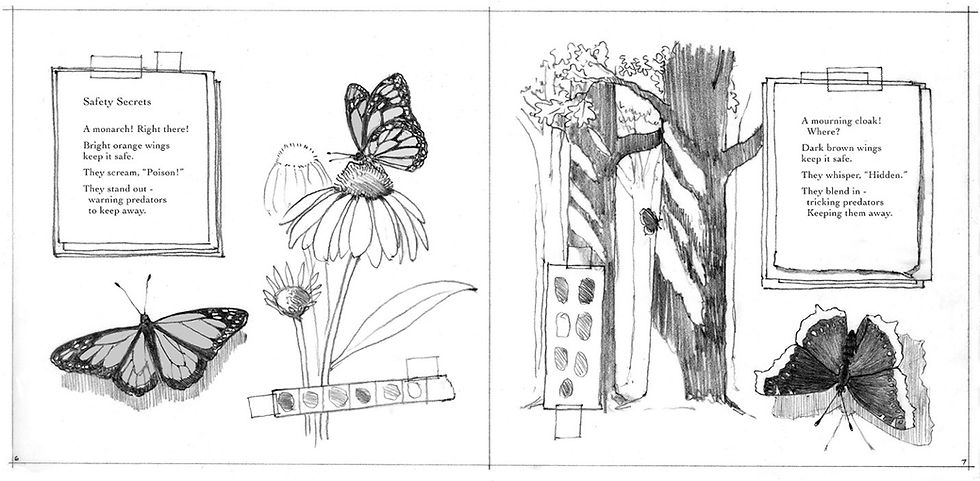

Text © Melissa Stewart, 2026. Image © Sarah S. Brannen, 2026.
We kept on working and, soon, everything was ready for submission. Along with the manuscript, we sent three sketches and a final piece of art. Two months later, we got great news. The book was accepted!

Karen Jameson – Who Nests Here? Twenty-Four Extraordinary Animal Homes (3/10/2026) – While researching something else entirely, I came across an article about strange places that birds build nests. I wondered if I could dig up even more interesting and intriguing examples, and in doing so discovered that all sorts of animals exhibit nesting behaviors.
The book was initially a mix of birds and other nesters, until my savvy critique partners suggested that I take ALL the birds out! Challenge accepted! I ran with that new hook and had so much fun. Along the way the original title, NESTING: NO BIRDS ALLOWED, evolved into Who Nests Here? Twenty-Four Extraordinary Animal Homes.

Alison Pearce Stevens – When Beavers Move In (3/10/2026) – I first discovered the Tulalip Tribes Beaver Project in 2021, when I was writing an article about rewilding for Science News Explores. I interviewed Molly Alves, one of the biologists working with the tribes to relocate ‘nuisance’ beavers from the Puget Sound area up into the Cascade Mountains on traditional Tulalip territory. I could have included beavers in Animal Climate Heroes, but I felt they deserved their own book. Later, when I came across a research paper that showed how beavers help suppress wildfires, and I knew it was time for beavers to shine. Fortunately, my editor, Laura Godwin, loves beavers as much as I do, so she was keen to pick this story up. And I was thrilled when Natasha Donovan agreed to illustrate. Her work is magical.
I love all the different ways that these books originated and developed. Is there anything special you want your readers to know about your book?

Text © Jilanne Hoffmann, 2026. Image © Khoa Le, 2026.
Jilanne Hoffmann – The Ocean’s Heart: The Tiny Creatures Essential to Life (3/3/2026) – The end papers show an illustrated satellite image of the Monterey Bay. I set the story there because it’s the site of the Monterey Canyon, an ocean trench that’s equivalent in depth to the Grand Canyon and extends nearly 300 miles offshore. It’s one of the largest and deepest ocean canyons in the world. It’s also a protected marine sanctuary and the site of the Monterey Bay Aquarium Research Institute (MBARI), a world-renowned marine biology research center. MBARI’s website is a testament to the diversity of species found in the bay, and their immense catalog of photos and videos served as a critical resource for me as I wrote and revised the book. It also turned out to be a critical resource for the illustrator, Khoa Le. Steven Haddock, the marine biologist who reviewed the book’s content at every stage, has worked at MBARI for over twenty years, and has taken many of the site’s photos and videos during research trips. His new coffee table book for a general audience, The Radiant Sea, describes the different ways creatures make light in the ocean. It’s spectacular! Super engaging and filled with stunning photos.

Text & Image © Sarah S. Brannen, 2026.
Melissa Stewart - Monarch and Mourning Cloak: A Butterfly Journal (3/3/2026) – Sarah really prefers to sketch from life rather than photos, so as she was creating the art for the book, she raised 11 monarch butterflies and kept a journal.
It’s very difficult to raise mourning cloaks, but an educator at a local nature center shared video of a mourning cloak going through the process, and that was a big help.

Text © Karen Jameson, 2026. Image © Ramona Kaulitzki, 2026.
Karen Jameson – Who Nests Here? Twenty-Four Extraordinary Animal Homes (3/10/2026) – That’s a great question! There are all kinds of exciting facts I unearthed while writing this book, such as the tunneling behavior of naked mole rats (known as volcanoing) and the compost heaps American alligators build to incubate their eggs.
I want my readers to know that anyone can be a nature detective by examining the clues creatures leave behind – footprints, shells, markings, etc. The global takeaway is that we can all be stewards of the land and animals by following a few of the simple suggestions in the back matter.

Text © Alison Pearce Stevens, 2026. Image © Natasha Donovan, 2026.
Alison Pearce Stevens – When Beavers Move In (3/10/2026) – Rewilding can heal natural spaces in ways people can’t do on our own. When we team up with nature—work with it instead of against it—we can address our planet’s problems faster and more efficiently.
These are all such interesting books and beautiful illustrations. What was the hardest, or most challenging, part of writing or researching your book? Was there a bit of your research you didn’t get to include?
Jilanne Hoffmann – The Ocean’s Heart: The Tiny Creatures Essential to Life (3/3/2026) – Ha! The back matter for my first draft was 7,500 words long. I wanted to tell kids about all of the different types of
zooplankton, the different ways they moved, ate, made light, and evaded predators, etc. My agent, Lori Steel, reined me in, forcing me to cut it to 2,500 words.
Before the second round of submissions, I cut it in half again. Then after Carol Hinz at Millbrook acquired it, I had to cut more, including a graphic and description of the ocean’s water column. Sigh. But I’m thrilled that Millbrook hired an infographic specialist to create the food web image from my scrawled sketch—that had been “prettied up” by a critique partner who’s an illustrator. I LOVE the way it (and the rest of the book, including the back matter) turned out! I think it’s just right amount of info for the K-5th grade crowd.
Melissa Stewart - Monarch and Mourning Cloak: A Butterfly Journal (3/3/2026) – Because the text consists of short poems, initially, there was a TON of information that I had to leave out. But when our editor accepted the book, she suggested adding A LOT of backmatter—12 pages. That allowed us to include lots of expository explanations accompanied by even more illustrations. It was a dream come true for both of us.
Karen Jameson – Who Nests Here? Twenty-Four Extraordinary Animal Homes (3/10/2026) – Oh, my goodness! The endless fact checking is absolutely the most challenging, especially now when a lot of previously trusted websites are being altered (or are forced to alter facts due to politics). And don’t get me started on AI. Very frustrating.
One animal that was particularly challenging was the sand crab. A few things never occurred to me: 1) The prints they leave ARE NOT footprints! They’re antennae prints. 2) They have to face the sea in order to survive. 3) The prints are washed away every time a wave comes in, so it’s hard to get photos of them. 4) This species is a west coast crab, and the editor and illustrator had never heard of or seen them. I live in CA, so those are the sand crabs I’ve seen my whole life. When the illustrations kept coming back featuring a sideways walking crab with pincer-shaped claws, I was puzzled. It took a while to figure out what the disconnect was. Ha! Cliffhanger: To get a gander at these peculiar crabs and find out WHY they face the sea you’ll have to read the book!
Alison Pearce Stevens – When Beavers Move In (3/10/2026) – I had wonderful interactions with Molly and members of the Tulalip Tribes, but it was all done remotely. I didn’t get to go into the field for this book, and I wish I could have done so. I would (still) love to tag along with the beaver project biologists as they capture ‘nuisance’ animals and—even better—release beaver families into their new homes. Maybe one day!
I love all the great information you all worked into your back matter. Are there any upcoming projects that you are working on now that you can share a tidbit with us?
Jilanne Hoffmann – Hmmm. I’m working on a novel that may end up being a mystery. A picture book about a vegetable. A picture book from the POV of inanimate characters. A picture book inspired by a true newspaper account from the Gold Rush. I could go on but will stop there.

Melissa Stewart - Yes, in July—during Shark Week—my next book, Sharks in Kansas: The Ancient See in the Middle of America, will enter the world. Set 180 million years ago, it tells the story of the Western Interior Seaway—an ocean that once divided the North American continent in two.
For reasons scientists don’t understand, the number of top predators was extremely high in this waterway compared to most other environments on Earth. There were more than a dozen different shark species as well as turtles the size of a car, and giant reptiles called mosasaurs and plesiosaurs. I think many people are going to be surprised by this book!
Karen Jameson – The Secrets Of The Squid, the follow up to The Secrets Of The Jellies, is in the works at the moment. It takes us out of the aquarium and follows a research ship into the open ocean to study these fascinating creatures. Incredible Jellies artist, Marie Hermansson, returns to illustrate this companion title. Release date set for spring ’27.
Alison Pearce Stevens – My next book also showcases how a small group of dedicated people can transform a waterway. The Wild Mile features the work of Urban Rivers, a small nonprofit that has begun rewilding the Chicago River in the city of Chicago. They’re using floating walkways surrounded by floating gardens of native plants creating the world’s first floating eco-park. It’s beautiful and is already attracting wildlife that’s long been absent from the area, and their efforts are reconnecting people with the river by giving them access to the water—something that’s been missing along most stretches through the city. And it’s all happening because a handful of people were determined to make a difference.
Intriguing. We'll have to keep our eyes open for these books. Last question, who is your STEAM hero or heroine, living or dead (scientist, naturalist, author, teacher, etc.)? Why?
Jilanne Hoffmann – Teachers who make STEAM come alive in the classroom are my true heroes. They’re the ones we need right now, the ones who help light the fire of kids’ curiosity and thirst for knowledge and make sure kids get a dose of critical thinking in the process. Once that fire starts to burn, kids will discover their own STEAM heroes active today or from history.
Melissa Stewart - Rachel Carson. If it weren’t for her ground-breaking work as a scientist and a writer, our planet would be in even graver danger right now. Silen Spring led directly to the Clean Air Act, the Clean Water Act, the Endangered Species Act, and the founding of the Environmental Protection Agency. Let’s hope we can find a way to rekindle the single-minded determination she brought the environmental movement before it’s too late to save our precious planet.
Karen Jameson – My fellow STEAM Team creators are my heroes! I am constantly in awe of the brilliance, creativity, talent, and innovation bubbling up from this dedicated group of nonfiction wizards. It’s exhilarating to be part of a team that prioritizes quality nonfiction for children everywhere and extends a hand to help one another at every opportunity.
Alison Pearce Stevens – This is a tough question. I personally know and frequently interview so many talented scientists who are making a difference in how we understand our world. But I think I’ll say Mike Breed. He was my Honors Biology professor my freshman year of college; at the end of the year, he invited me to work in his lab. It was an incredible opportunity that launched my career as a scientist and got me where I am now.
NOW, let me take a moment to introduce you to this amazing STEAM book!
The Ocean’s Heart: The Tiny Creatures Essential to Life by Jilanne Hoffmann, illustrated by Khoa Le (Millbrook Press 3/3/2026) – Examining the numerous fascinating and bizarre zooplankton found in the ocean, this book provides tantalizing translucent images and unusual facts (like jellyfish are considered zooplankton) presented with an engaging, lyrical, conversational tone. It transports the reader on the tiny creatures nightly journey from the ocean's twilight zone to the surface, evading fish, seals, and whales as they search for the phytoplankton at the surface. Participating in the largest animal migration in the whole world, readers learn how important zooplankton are to our survival and the survival of everything on earth. Two vertical spreads help highlight the distance up (and then down) which they travel each night. Excellent back matter, with a great food web and section on how we can help them, rounds out this stunning, absorbing look at these super important, beautiful creatures.
Synopsis: Far below the ocean's surface / live tiny, restless creatures / called zooplankton. / They are the ocean's heart.
The largest migration of animals on Earth happens every single night as billions upon billions of microscopic animals―zooplankton―paddle from the ocean’s depths to its surface. On their journey, they swim daunting distances through predator-infested waters in pursuit of a midnight feast. Zooplankton are so small, and they live so deep, that we may never see them―but the entire food web depends upon their survival. Venture into the ocean’s twilight zone with Jilanne Hoffmann’s lyrical, evocative prose and Khoa Le’s luminous illustrations of these tiny yet magnificent creatures.
Monarch and Mourning Cloak: A Butterfly Journal by Melissa Stewart, illustrated by Sarah S. Brannen (Beach Lane Books 3/3/2026) – Sandwiched between detailed front end pages showing the monarch butterfly's life cycle, various stages, and habitat map and rear end pages with the sample details for the mourning cloak butterfly, is an ingenious, lyrical text written on notes "taped" into a detailed scientific artist's journal - complete with color samples, brushes, and sketches, as well as date and location notations. Through an observational comparison, the book explores how to spot these two butterflies, where they live, their reactions to fall and winter, and their similar metamorphosis. Stunning backmatter explores journaling, sketchbooks, and provides detailed notes, diagrams, and maps for each of the sections in the book. It is a wonderful example of scientific observation and journaling and a fascinating look at these two special butterflies.
Synopsis: A luminously illustrated and thoroughly informative picture book poetry collection by Sibert Honor–winning duo Melissa Stewart and Sarah S. Brannen that captures the beauty and complexity of monarch and mourning cloak butterflies.
Monarch and mourning cloak butterflies may seem similar on the surface; they are about the same size and common throughout North America. But following along at a butterfly’s-eye-view, readers will discover how they live in different habitats, eat different foods, and have different strategies for avoiding enemies and making it through winter. Because even though all butterflies have the same basic body features and life cycle, each species has its own special way of surviving.
Delightful and illuminating poems, informational sidebars, and lush illustrations will immerse curious young readers in the lives of these two fascinating butterfly species.
Who Nests Here? Twenty-Four Extraordinary Animal Homes by Karen Jameson, illustrated by Ramona Kaulitzki (Beach Lane Books 3/10/2026) – Using a fun two spread format, the book shows a series of three nests found in trees, mud, sand, water, plants, dirt, rocks and snow and the footprints, debris, or markings about the nests. Then on the next spread reveals who lives in these nests. The back matter includes additional information about the animals and their nests, as well as guidance on safety around nests and conservation. It's a wonderful exploration of some unusual nests and animals not often associated with "nests."
Synopsis: Meet twenty-four extraordinary animals and the different nests they call home in this lyrical nonfiction environmental picture book perfect for fans of Kate Messner’s Over and Under series and Jennifer Ward’s Mama Dug a Little Den.
Who nests here?
Whose baby bed?
Whose family home?
Whose winter shed?
Clues are waiting up ahead!
Calling all nature detectives! Use clues to guess the animal each shelter belongs to, discovering twenty-four extraordinary creatures—not a bird among them!—and the tree, mud, sand, water, plant, dirt, rock, and snow nests they call home.
When Beavers Move In by Alison Pearce Stevens, illustrated by Natasha Donovan (Goodwin Books/ Henry Holt 3/10/2026) – Starting with beavers building their lodge too close to a family's house, the wonderfully succinct text and stunning illustrations follow the rewilding of the beavers and the environmental changes that these keystone animals have on the forest environment. Examining the benefits they provide for insects, fish, plants, other animals, flood prevention, and fire protection. A great author's note describes the Tulalip Tribes work rewilding beavers, facts about beavers, and a call to action round out this wonderful look at the special role beavers play.
Synopsis:
When beavers move in, they chew down a tree.
They nibble the bark.
And they drag the branches into a stream.
Beavers topple trees and build dams, which can cause floods and disrupt neighborhoods. So what do we do when beavers move in? In Puget Sound, we call the Tulalip Tribes. They send biologists to help relocate our furry friends to a place far from people, where the beavers can be free.
Poetic text and gorgeous art make this an irresistible read with gentle STEM tie-in.
Thank you all for giving us a little peek into yourself and your new books. Wishing you all enormous success with you upcoming projects.
Jilanne Hoffmann – The Ocean’s Heart: The Tiny Creatures Essential to Life (Millbrook Press 3/3/2026) –
Website: https://jilannehoffmann.com/
Instagram: https://www.instagram.com/jilanne2694/
Melissa Stewart - Monarch and Mourning Cloak: A Butterfly Journal (Beach Lane Books 3/3/2026) –
Website: https://www.melissa-stewart.com/
Karen Jameson – Who Nests Here? Twenty-Four Extraordinary Animal Homes (Beach Lane Books 3/10/2026) –
Website: https://karenljameson.com/
Instagram: https://www.instagram.com/kayljameson/
Alison Pearce Stevens – When Beavers Move In (Goodwin Books/ Henry Holt 3/10/2026) –
Website: https://apstevens.com/
Instagram: https://www.instagram.com/alisonpstevens/


Comments