
How a Bear Became a Book - Perfect Picture Book Friday #PPBF
First off - I LOVE all things Winnie-the-Pooh! He was a dear favorite of my kids growing up, too. And it's so interesting how some of the Hundred-Aker-Wood's wisdom can still be so relevant in adulthood. I am also a huge fan of Faith Pray and Annette Bay Pimental - what a great combination for this unusual nonfiction which highlights the process of making a book and celebrates the 100th anniversary of the "best bear in all the world."

How a Bear Became a Book: The Collaboration That Created Winnie-the-Pooh
Author: Annette Bay Pimentel
Illustrator: Faith Pray
Publishers: Henry Holt and Co. (BYR) (March 31, 2026)
Ages: 4 - 8
Nonfiction
Themes:
Making stories, Winnie-the-Pooh, and imagination.
Synopsis:
Celebrate the 100th anniversary of Winnie-the-Pooh with this gorgeous picture book about the creation of the World's Most Famous Bear!
In 1926, the very first Winnie-the-Pooh book was published. One hundred years later, generations of kids have grown up in the Hundred Acre Wood.
How a Bear Became a Book tells the story of how writer, illustrator, and editor came together to craft Pooh's first adventure. But deeper than that, this book introduces our youngest readers to how stories begin and where they can go. As Pooh's voice enters the text, he slowly comes to life in the art.
Textually delightful and visually stunning, this is a picture book about the making of picture books, but it is also a masterful exploration of ideas, storytelling, collaboration, art, and most importantly, honey.
Opening Lines:
Alan Alexander Milne was an author. He wrote stories.
One day he had an idea and he wrote down some words about a bear.
A bear?! Where?
Oh. Me!
The words lingered on the page . . . waiting.
Waiting, waiting, waiting.
Wait!
What am I
waiting for?
What I LOVED about this book:
What a fun way to create a nonfiction about the collaborative process between an author, illustrator, and editor needed to build a book. I adore the additional metafictional aspect in the text and the illustration that slowly bring Winnie-the-Pooh "to life" on the pages of the book. Be sure to sit a moment with Faith Pray's gorgeous end papers which beautifully bookend this story.
The illustration's depiction of Mr. Milne writing the story for his son, as sheets of blue pages floating through the air and transforming into orange pages and the start of a very soft outline of Pooh bear, is simply ingenious! It highlights not only imagination, but the loving relationship between the father and son.

Text © Annette Bay Pimentel, 2026. Image © Faith Pray, 2026.
Through the playful banter between the boy and the orange shape of a bear, the readers are introduced to the idea that words need more. Lyrics need music, scripts need actors, and books need pictures. Wonderful illustrations show the boy creating drawings and introduces Eeyore, Piglet, Rabbit, Owl, and a honey pot. With each successive spread, the orange shape becomes more distinctly recognizable as "loose sketches" of Pooh. Each ingeniously filled with words from the original stories.
Another important part of making books is the editor, who helps find the pictures. With a fun combination of narration and Pooh's innocent comments, Annette Bay Pimentel beautifully describes the process that the editor and Mr. Milne took to find the just right illustrator. These illustrations are absolutely stunning. At one point, a clothesline stretches over the heads of the boy and Pooh with five different illustrator's attempts clipped to the line. I love that one of the original book's quintessential lines, "Silly old bear," made it into the scene when Pooh offers to "catch an illustrator." Turns out they needn't have worried, the first rejected illustrator (Ernest Shepard), after he spent time with the words, visited the house and woods, and watched the boy and bear play, was the right one all along.

Text © Annette Bay Pimentel, 2026. Image © Faith Pray, 2026.
I love how Faith Pray was able to capture the imagination and whimsy that embodies the Pooh books in her illustration of Ernest's sketches where he adds "make-believe to his real-life drawings." The color palette smudges around the images are a really fun addition that make it feel like we are peeking into Ernest's process.
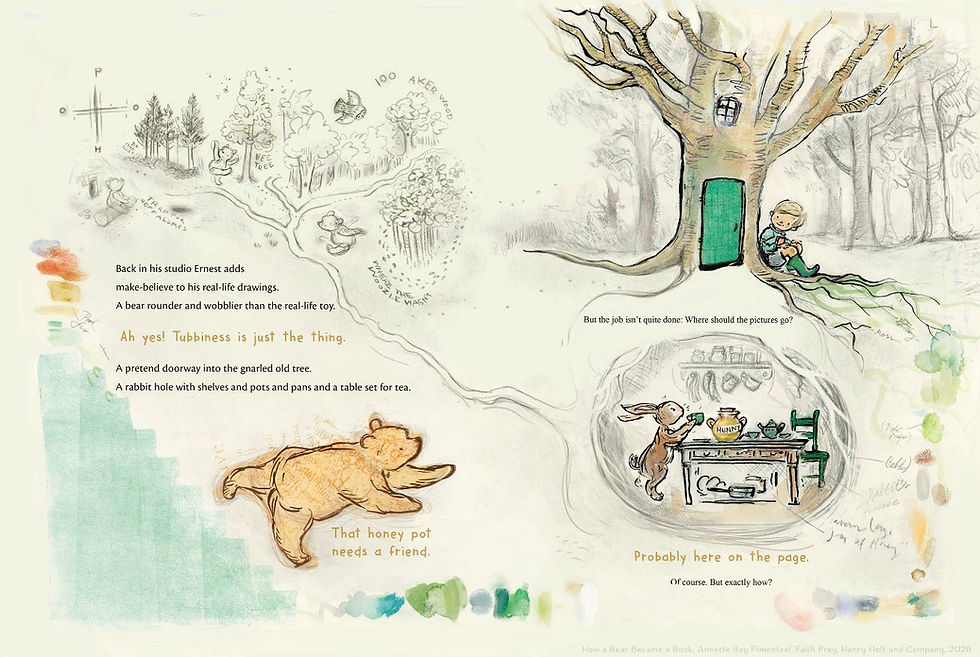
Text © Annette Bay Pimentel, 2026. Image © Faith Pray, 2026.
A spectacular discussion between the text and the illustration was given room to experiment and physically play with the decisions about how to place the pictures and the words on the pages together. It is wonderful that this book was given the space to creatively and demonstrably introduce readers to how books are created. At last, the book was done and Pooh is solid. There are so many amazing moments and illustrations in this book - I hope you are able to discover them for yourself.
The ending is both touching and a wonderful explanation of the magic that words and pictures create when they bring characters to life. A fun note offers additional information on the author, illustrator, and editors of the Winnie-the-Pooh books, with a title that calls back to those books - "In Which We Learn More about Alan, Ernest, and Their Editors." Further descriptions of Alan and Ernest's revolutionary melding of words and images and fun notes on the current author, illustrator, and editors round out the back matter.
This is a magnificent celebration of Winnie-the-Pooh's 100th birthday and the magic and make-believe that Alan, Ernest, and Edward have given to generations of children. It is also a spectacular look at the steps and teamwork involved in the creation of a book.
Resources:
do you have a favorite stuffed animal, doll, vehicle, or other item like a rock? Make up a story for your chosen friend or item. Draw some pictures to go with the story. Or make a wordless story with just pictures.

now, decide how you are going to put the story and pictures together and make your own book.
check out the great educator's guide for the book.
If you missed my interview with Annette Bay Pimentel and Faith Pray on Monday, find it (here).
This post is part of a series of blog posts by authors and KidLit bloggers called Perfect Picture Book Fridays. For more picture book suggestions and resources see Susanna Leonard Hill's Perfect Picture Books.


Comments