
The Picture Book Buzz - Interview w/Annette Pimentel and Faith Pray
Updated: Apr 3
Annette Bay Pimentel is the fifth child of a fifth child of a fifth child. She married a fifth child. And they have 5 + 1 children.

Annette lives in northern Idaho. As a child, she didn’t like nonfiction. Now, she writes true stories about real people for young readers.

She’s the award-winning author of more than twenty books, including Before Colors: Where Pigments and Dyes Come From, illustrated by Madison Safer (2023), Before Music: Where Instruments Come From, illustrated by Madison Safer (2022), Pura’s Cuentos: How Pura Belpré Reshaped Libraries with Her Stories, illustrated by Magy Morales (2021), All the Way to the Top: How One Girl’s Fight for Americans with Disabilities Changed Everything, illustrated by Nabigal-Nayagam Haider Ali, foreword by Jennifer Keelan-Chaffins (2020), Girl Running. illustrated by Micha Archer (2018), Mountain Chef: How One Man Lost His Groceries, Changed His Plans and Helped Cook up the National Park Service, illustrated by Rich Lo (2016), and educational press books, including twelve books in the Do You Really Want to Meet…a Dinosaur? Series, illustrated by Daniele Fabbri.
Faith Pray (yes, that’s her name, by marriage) is an award-winning author-illustrator from Port Townsend, Washington.

After a stroke left her struggling to find her writing self again, Faith set out to tell stories through art as a form of therapy, and rediscovered picture books. Faith has since written and/or illustrated eight books for children, with more in the works. When not writing, illustrating, or wrangling four kids and a mischievous band of animals, Faith loves to sketch at the beach, explore the woods, visit cat cafés, and of course, read all the books.

Faith is the author/illustrator of The Day We Got Lost (2024), Perfectly Imperfect Mira (2022), and The Starkeeper (2020). And she’s the illustrator of Finding Grateful by Dianne White (2024), One Day by Joanna Ho (2023), and Once Upon a Timely by Lynn Parrish Sutton (2019).
Their newest picture book, How a Bear Became a Book: The Collaboration That Created Winnie-the-Pooh, releases March 31st.
Welcome Annette and Faith, thank you so much for coming back to talk about your newest book and your writing.
Thank you so much for having us, Maria!
What is one of the most fun or unusual places where you’ve illustrated a manuscript or created an illustration?
ANNETTE – I write on a treadmill desk at home in Idaho, but a big chunk of this book was written when our family was living in Austria. Contemplating the move, I was worried about not being able to walk while I worked, but once there, I discovered near our apartment a co-working space called Schreiboase, or Writer’s Oasis, and they had a treadmill desk! I joined and worked on that treadmill desk every day.
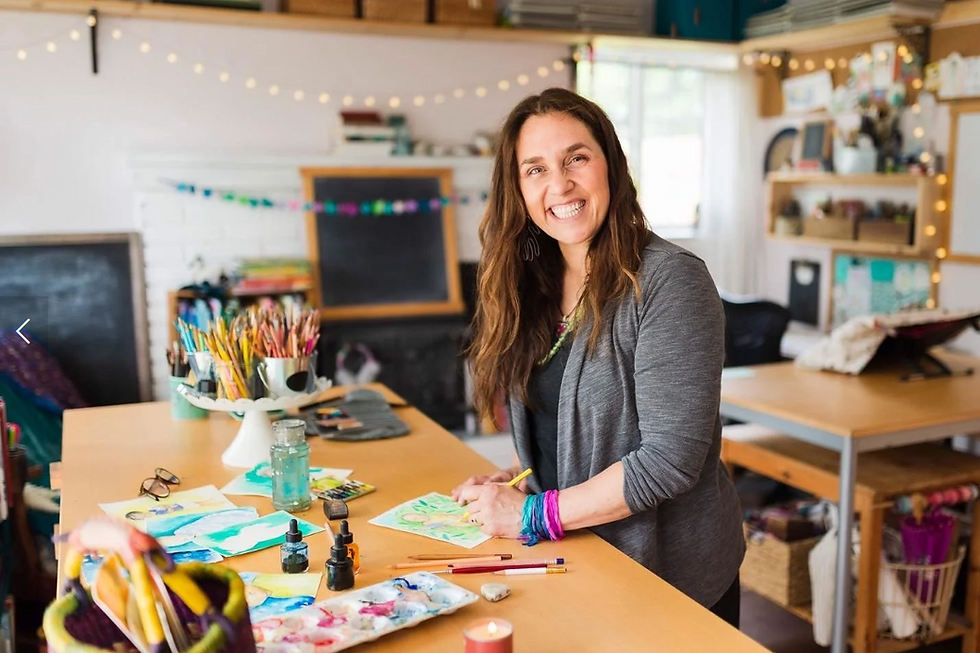
Image © Faith Pray, 2026.
FAITH - Most of the time, I work on book art in my studio, but I love that story spinning can happen everywhere. I have sketched and brainstormed stories on ferry rides, during kids’ soccer practices, violin lessons, doctor visits, and walks. I like to think writing and creating can turn even the most mundane setting into something magical. I keep pencils and sketchbooks with me everywhere and try to keep open to all the possibilities.
Writing in Austria and sketching on ferries sound like lots of fun. Annette, what was your inspiration or spark of interest for How a Bear Became a Book: The Collaboration That Created Winnie-the-Pooh? How did you come up with this strategy for telling the story of the creation of Winnie-the-Pooh?

ANNETTE - I loved the Winnie-the-Pooh novels when I was a child, and when I married my father-in-law introduced me to Milne’s and Shepard’s books of poetry. He had received a copy of When We Were Very Young as a birthday gift in 1925, and I now have that volume next to my desk.
As our family was preparing to live abroad during my husband’s sabbatical year, I looked for projects that I could research in Europe. I saw that the 100th anniversary of the publication of Winnie-the-Pooh was coming up, and I realized that I’d never read about E. H. Shepard’s role in that book, so I decided to try to do a picture book biography of him. As so often happens, the research nudged me in a new direction, exploring the collaboration between Milne and Shepard.
I love how research sometimes opens remarkable worlds we never thought. Faith, what about the How a Bear Became a Book manuscript appealed to you as an illustrator?

Image © Faith Pray, 2026.
FAITH – I have always been a huge fan of Ernest Shepard’s work, and Winnie-the-Pooh stories and poems were my favorite books from childhood, so the subject matter had me immediately hooked. Not only that, but Annette’s text is captivating. I found it complex and curious and the idea of finding a visual story to match the words was the most enthralling puzzle. I couldn’t wait to get started.
It does sound like it would be a really fun challenge. How many revisions did How a Bear Became a Book take for the text or illustrations from your first draft to publication?
ANNETTE – I did 20 drafts before we circulated the manuscript to publishers. I did 3 rounds of revision with the editor, Mark Podesta, to clarify the structure, refine the language, and add more gentle humor.
FAITH - How a Bear Became a Book is a book about making a book, and also about the making of an iconic character, and about collaboration. It’s also a book told in these overlapping threads of story. When I read the text, I pictured each thread of story weaving together, layered in different mediums But the process of making the art required tons of deep thinking and experimentation to get there.
In order to map out how the overlapping layers of voices would look on the page, I cut up the manuscript and spread it all out onto a huge storyboard. Then I did thumbnail sketches on transparent sticky notes for each frame of the storyboard, and color coded each thread of story so that I could see a map of how the whole book might look.
Once I mapped everything out, I had to find a different medium for each layer of story. That took lots of trial and error and experimentation. I ended up using pencil, ink, watercolor, screen printing, and reverse transfer printing to give each thread of story its own look.
Wow, thank you for sharing this. It sounds like it was a pretty trick puzzle to work out. Readers are going to love seeing how you solved it. Annette, what was the toughest part of researching and/or writing How a Bear Became a Book? What was the most fun?
ANNETTE - Figuring out the structure of the book was definitely the hardest part. My first drafts had the familiar structure of a picture book biography, focused tightly on Shepard and with no sign of a chattering bear anywhere. My critique group (hats off to the Brain Trust!) kept asking me what I cared most about in the story. Trying to answer their question led me to realize that I was fascinated by the way the text and the illustrations work together in the Pooh books.
At the same time, another critique partner, Eija Sumner, was sharing with me early drafts of her metafiction picture book The Good Little Mermaid’s Guide to Bedtime. Watching how that book was taking shape emboldened me to try metafictional elements in my nonfiction book. I added Pooh as a narrator, letting him comment on the process of creation. It made the structure complicated, with several narrative threads, but it was a lot of fun to play with, and slowly a workable structure emerged.
It's so fun to see authors play with metafiction in nonfiction books. Faith, what was the toughest part of your research and/or illustrating How a Bear Became a Book specifically? What was the most fun?
FAITH – I wanted the book to feel new while still honoring its historical grounding, I’d say that I felt most challenged while illustrating How a Bear Became a Book when figuring out how to visually weave the story threads together.
But the historical research part of this project required deep dives as well. I wanted the book to feel new while still honoring its historical grounding, so I read stacks of books by and about E.H. Shepard and A.A. Milne, requested copies of manuscripts, sketches, and letters from archives, dug up old films of Milne and Shepard writing, talking, making art, walking around near the Hundred Acre Woods. And then I spent hours sketching it all to get a better idea of my sense of person and place.
And the most fun? I loved all of it - the thrill of research, of learning new things, working in ink and watercolor, and experimenting with new art processes and mediums to try to get the looks I wanted. It was incredibly fun.

Image © Faith Pray, 2026.
The illustrations were created with pencil, ink, and watercolor on Saunders Waterford hot press paper, screen and reverse transfer printing on Yasutomo mulberry paper using printing ink, freezer paper, and scans from a reproduction of A.A. Milne’s original Winnie-the-Pooh handwritten manuscript, archived letters written in Milne and Shepard’s handwriting, and my childhood copy of Winnie-the-Pooh.
As intensive as that was, it sounds fascinating and like a lot of fun. Annette, when you first saw Faith’s illustrations in How a Bear Became a Book did anything surprise, amaze, or delight you? Which is your favorite spread?
ANNETTE – The first illustrator who had been offered the job turned it down, saying the book was fundamentally un-illustratable. Her reasoning was sound: an illustrator’s job is to design a character, but my text was asking the illustrator to design a character who would keep changing right up until near the end of the book.
I was panicked that she was right and that my text simply would not work with illustrations. So, I was relieved and delighted when I saw Faith’s initial sketches. She had somehow solved the almost-impossible puzzle my text had given her.

Text © Annette Bay Pimentel, 2026. Image © Faith Pray, 2026.
I love the spread about the publication of the book. On the left side of the spread, Faith has drawn the author, illustrator, and editor watching 1920s customers enjoying the book. On the facing page, she has drawn modern-day kids reading the books. It’s a lovely depiction of the enduring nature of Winnie-the-Pooh.
I am so glad that Faith could envision what this fun text could become! Faith, is there a spread that you were especially excited about or proud of? Which is your favorite spread?
Text © Annette Bay Pimentel, 2026. Image © Faith Pray, 2026.
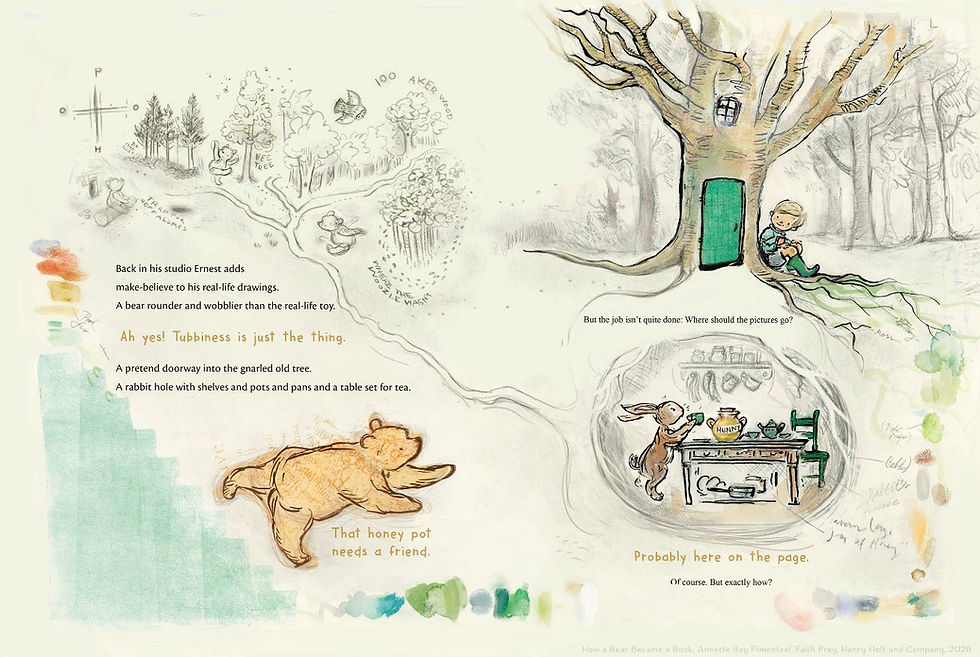
FAITH - My favorite spread is the one where, after Ernest Shepard had spent time sketching at Milne’s house and the surrounding Forest, he went back to his studio and began to add make believe to his sketches. I wanted the illustration to feel transformative, so it’s a mix of pencil sketches, ink, screen printing and reverse transfer printing, and then I asked my editor Mark and art director Melisa if we could include the outer edge of the artboard, where I test paint daubs for accuracy. It reminded me of some of Shepard’s sketch studies. I like how it all turned out. You can see a door in a tree, and a partially finished drawing of Rabbit’s house, and there’s a penciled map of the ”Hundred Acer Woods.”
I adore this image! As a fan of Winnie-the-Pooh, I love seeing the generation and beginning progress of these beloved books. And I love your composition and the idea of leaving the color samples along the edges. It's stunning. Is there anything you want your readers to know or discover about How a Bear Became a Book?
ANNETTE – I hope kids will read our book and feel awe and wonder that a group of people can come together and create something delightful and enduring. I hope it gives them trust in the power of community.
The undercurrent in all my books is my deeply-held belief that the way the world is right now is not the way it has to remain. We shape our world. I hope this book gives kids a spark of encouragement to explore their imaginations, and to share their dreams with others—to collaboratively create the world they want to live in.
FAITH - I hope How a Bear Became a Book will infuse them with fascination at the evolution of stories, the power of imagination, and of their own potential as readers and creators. And I hope our book will inspire readers to find their way into Milne and Shepard’s Winnie-the-Pooh books, too.
I am pretty sure that both of your hopes will come true. Annette, was there anything in your research that you wished you could have included in the book or back matter?
ANNETTE – I love back matter because it lets me toss in the fascinating bits that don’t belong in the main story. Our publication team was very generous in giving us so much space for the back matter. The only extra thing I would have loved to include would be examples of Shepard’s art, but Faith’s art does a beautiful job of evoking that art (and it’s easy to Google, if you’re intrigued!).
Faith, many illustrators leave treasures or weave their own story (or elements) throughout the illustrations. Did you do this in How a Bear Became a Book? If so, could you share one or more with us?
FAITH - Each bear in our book was made up of handwritten and typed words from Milne and Shepard’s stories and letters related to what was happening on the page. For example, there’s a page where our Christopher Robin-esque narrator gives balloons to Winnie-the-Pooh and friends. The bear on that page is made up of words from chapters about balloons. The bear on the cover is made up of stories where Winnie-the-Pooh is being introduced.
Themes of windows and stairs feature often in Milne and Shepard’s When We Were Very Young, Now We are Six, Winnie-the-Pooh, and The House on Pooh Corner, so I used window elements throughout, and there are also faint stairs hidden in nearly every spread in the book.
Thank you for sharing this with us. Are there any projects you are working on now that you can share a tidbit with us?
ANNETTE – Turtle on the Tarmac is about what happens when a kid and a turtle independently arrive at the airport. It’s a celebration of wildlife conservation for very young readers and is coming out next year with Abrams.
Another book that I researched in our year in Europe, Numbers Tell Stories Too, is about Florence Nightingale’s pioneering work as a statistician. It will be published by Beach Lane in 2028.
FAITH - In September, my next author-illustrated picture book The Woodland Nutcracker arrives with Abrams. It’s sweet and sparkly, and full of peppermints and ribbons, and cute animals in The Nutcracker Ballet.
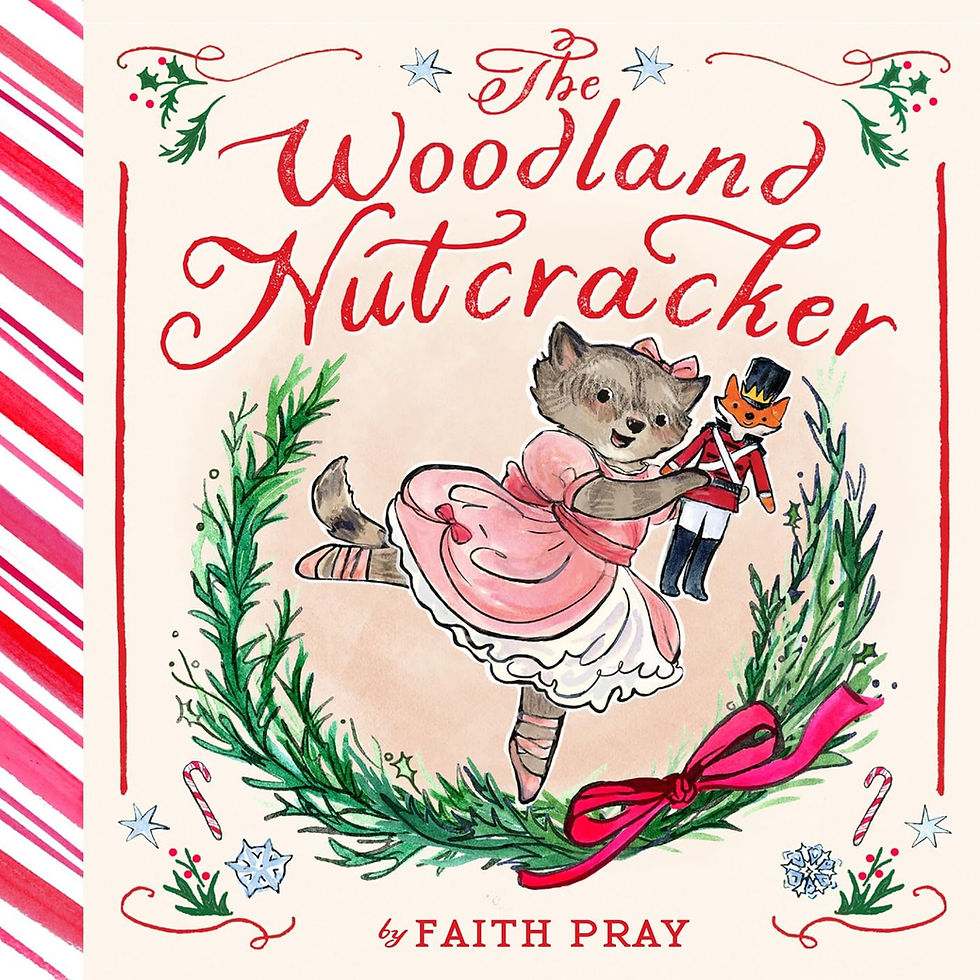
And I’m currently working on the next book in that series, The Woodland Cinderella.
These sound like amazing books! I can't wait to see them. What is your favorite National Park or Forest, regional park, or city park? Or the one you’re longing to visit. Why?

ANNETTE – I love Yosemite and all of the beautiful open lands around me in the Inland Pacific Northwest—shout-out to the private landowners of Moscow Mountain, who make the land accessible to all of us! The park I’m longing to visit is Glacier National Park. Even though we’ve lived just 300 miles away from Glacier for ten years now, I’ve still never visited! But it’s on the calendar for this year.

FAITH - I live in the Pacific Northwest, nestled in between mountains, water, and the Olympic National Forest, so I am pretty spoiled when it comes to favorite beautiful places. But I’d love to spend even more time adventuring. I have always wanted to visit Banff National Park and do book research there. And I’d love to go sketching and exploring down the Pacific Coast. Ooh, and I also have a dream of sketching and writing cross country on a train. Oh, and in the UK and Ireland if ever possible. And Alaska. And, and, and… Basically, point me in any direction and I probably want to go do some exploring there.
Thank you, Annette and Faith, for coming back to share your newest picture book with us.
To find out more about Annette Bay Pimentel, or contact her:
Website: http://www.annettebaypimentel.com/
Bluesky: @annettepimentel.bsky.social
To find out more about Faith Pray, or get in touch with her:
Website: https://www.faithpraybooks.com/
Substack: https://faithpray.substack.com
Facebook: https://www.facebook.com/faithpraybooks/
Instagram: https://www.instagram.com/faith.pray/
If you are in the area, check out Faith Pray's book events.

Tuesday, March 31, 2026 | Liberty Bay Books | “ How a Bear Became a Book” Launch Party | 6:00 pM |
Liberty Bay Books is offering 10 % discount when you pre-order a copy of How a Bear Became a Book.
Book-making talk, bears, games, and cookies! Come join us!
Wednesday, April 1, 2026 | Port Townsend Public Library | Book Launch Storytime | 10 aM & 11 AM
Join the party! Join either or both sessions as we read and chat about How a Bear Became a Book, and experiment with art.
Saturday, April 25, 2026 | Imprint Bookshop | Author Bookseller for Indie Bookstore Day
Imprint Bookshop, Port Townsend, WA
June 11-14 2026 | Children’s Art + Literacy Festival : A Hundred Acre Adventure | NCCIL (National Center for Children’s Illustrated Literature) | Abilene, TX |


Comments