
The Picture Book Buzz - Interview with Núria Figueras and Lawrence Schimel
Núria Figueras is the award-winning author of several books for children and young people.

She has a degree in Information Sciences, she is currently the editor of the children’s magazine El Tatano. Her writing has been recognized with the Mercè Llimona and Comte Kurt prizes. Núria lives in Barcelona, Spain.
She is the author of 14 books, and The Visit is her English-language debut.
Lawrence Schimel is a full-time author, writing in both Spanish and English, who has published over one hundred books in a wide range of genres. He is also a prolific literary translator.

His picture books have been selected for the White Ravens from the International Youth Library in Munich, Germany and have twice been chosen for IBBY’s Outstanding Books for Young People with Disabilities, among many other awards, honors, and Distinctions.
His work has been published in Basque, Catalan, Croatian, Czech, Dutch, English, Esperanto, Estonian, Finnish, French, Galician, German, Greek, Hungarian, Icelandic, Indonesian, Italian, Japanese, Korean, Maltese, Polish, Portuguese, Romanian, Russian, Serbian, Slovak, Slovene, Spanish, Turkish, and Ukrainian translations.
Lawrence started the Spain chapter of the Society of Children’s Book Writers and illustrators and served as its Regional Advisor for five years. He also coordinated the International SCBWI Conference in Madrid and the first two SCBWI-Bologna Book Fair conferences. He lives in Madrid, Spain and New York City.
For more information on Lawrence, see our earlier interview (here).
Their newest picture book, The Visit, releases in the U.S. on April 14th.
Welcome Núria & Lawrence, thank you so much for stopping by to talk about your newest picture book.
Hello, Maria! Thank you so much for inviting me to your blog.
Let’s start with Núria. Tell us a little about yourself. (Where/when do you write? How long have you been writing? What is your favorite type of book to write?)
NÚRIA - I find it very difficult to find moments to write, between work and family. I try to write in the mornings before going to work, when the world seems not to have fully awakened yet. And some afternoons, I take my laptop to the library, where I can really concentrate.
Writing has always accompanied me. When I was little, I used to invent stories and poems. I loved making words rhyme! As I got older, I kept writing, both poetry and stories. For my job, I also have to write a lot, especially short stories, often humorous, and it’s a genre I feel very comfortable in.
It is wonderful to "meet" you. What is one of the most fun or unusual places where you’ve written or translated a manuscript?
NÚRIA – I remember writing a story in the kitchen, standing, making an omelette with one hand while writing in a notebook with the other. My children were very young, and it was impossible to find time! Sometimes on the subway, I also jot down some phrases or ideas that come to me in a small notebook I always carry.
LAWRENCE – When I'm writing my own work, I tend to start all poetry writing longhand but most prose directly on the computer. For translations, I tend to work directly to computer as well, so I've wound up translating anywhere I have my laptop. If I'm on deadline, that might be on a plane or train to not lose time.
One year, I was staying with a friend for the London Book Fair but I locked myself out of her apartment! Luckily, the gluten-free bakery around the corner knew me (I went in every morning to stock up on provisions for the day) and they let me camp out in a corner to escape from the rain and keep working, until my friend came home from an after-work dinner.
Oh my goodness, Núria, I remember the days of one-handed everything. Lawrence, what a good thing you visited the bakery each morning! Núria, what was your inspiration or spark of curiosity for The Visit?

NÚRIA – The Visit came from the memory of the first time I stayed home alone. I must have been about eight years old, and my mother went out for a moment to buy something. The moment she left, I felt the house fill with silence. I lived in a very small apartment where there was always a lot of noise because we were a large family. I wasn’t used to silence! I felt afraid, like the little fox. Everything seemed different—my bedroom, the living room… As an adult, however, I’ve discovered that silence calms me and helps me connect with my thoughts. This positive view of silence is what I wanted to convey in the story.
What a great memory and while I agree silence can be calming, having spent a night in my Mom's house alone after she moved to memory care, I can definitely empathize with the little fox. Lawrence, what drew you to The Visit to translate it?
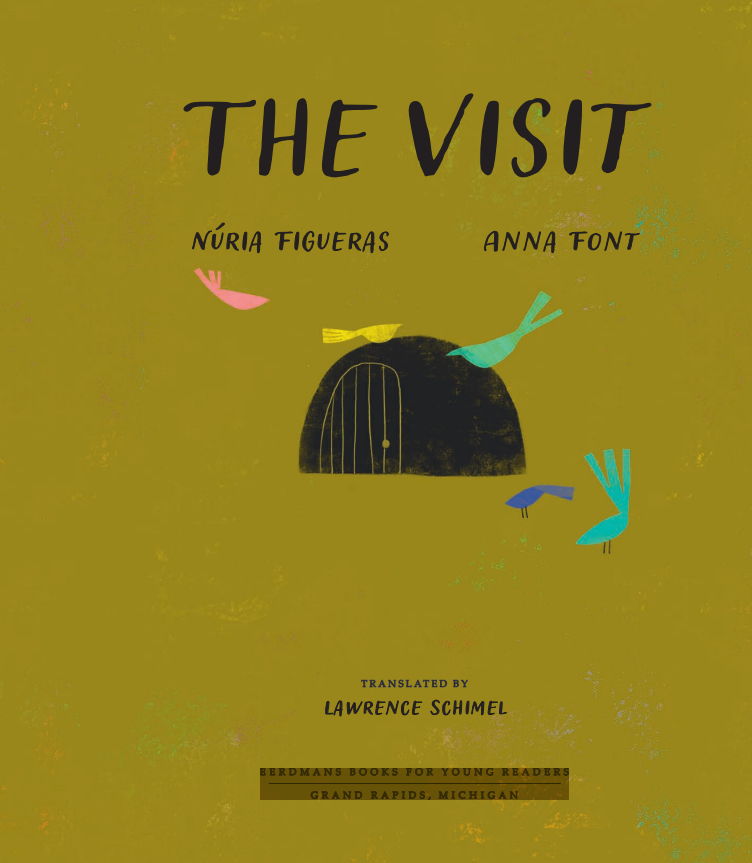
LAWRENCE – I published a picture book with Kalandraka (back in 2002) and have always tried to keep up to date with what they're publishing, and especially books that have won their Premio Compostela prize, like The Visit. Also, a friend in Belgium translated the book into French, and she and I have often "shared" different books and authors that we've each translated. I always say there needs to be a special word or term for that relationship, when two translators have each translated the same book into their language...
I'd love to know what word you would create for this relationship. Núria, what was the most difficult part of writing The Visit? And the most fun?
NÚRIA – Probably the most difficult part was the last page, which I wrote afterward, when I already considered the story finished. The publisher felt a final sentence was needed, and they were absolutely right! I thought about it a lot, and I’m glad I included the word “friend” in the relationship between the fox and Silence.
The most fun—or most exciting—part was seeing how, starting from the initial idea (that Silence knocked on the door), the story almost wrote itself. That’s how it felt! What I enjoyed most was accompanying the little fox: feeling her fear at the beginning and watching how it gradually transformed until she relaxed and felt comfortable in Silence’s company.
Thank you for sharing this and including a friendship between the fox and Silence. Lawrence, what was the most difficult or challenging part of translating The Visit?
LAWRENCE – The book is so spare and elegant, so recreating that in English was a challenge. Especially because of the way that abstract concepts are treated differently in Catalan and English. Something as simple as whether or not to keep the article for Silence.
My goal in translating is always to try and recreate the reading experience.
Oh, that sounds like it can be so complicated. I think you did a great job with this translation and I for one am so glad that you translated it! How many revisions did The Visit need from the first version to publication? Lawrence, how does that compare to your other picture book translations?
NÚRIA – I usually do many revisions when I write. Once I have a first draft, I really enjoy feeling the rhythm of each sentence and searching for the exact words I want to use. I love texts that flow smoothly, almost unnoticed. I also really enjoy cutting anything that feels superfluous. But once I have the final version and submit it to the publisher, I make very few changes.
LAWRENCE – I am a very fast first drafter and then revise a lot. For picture books, it's also important to read them aloud! And in a translation, my job is to be faithful to the original text and the editor's job is to be faithful to the end reader in the new language. So sometimes she'll make suggestions for changes, and we'll go back and forth to make sure we're both happy with whatever compromise we come up with that satisfies both the end reader and fidelity to the source.
Thank you for explaining that interaction Lawrence. It's very interesting to learn the particular focus of the translator versus the editor. Was there anything that surprised or amazed you when you first saw Anna Font’s illustrations? What is your favorite double-page spread?

NÚRIA – Everything surprised me! Anna Font is a wonderful illustrator with great artistic sensitivity, who creates from a place of authenticity. I was struck by the vivid, warm colors and, above all, by how she portrayed the character of Silence: with a single white line, because, as she explains, white is the absence of color (and silence is the absence of sound). I thought it was brilliant.

Text © Núria Figueras, 2023. Image © Anna Font, 2023.
English-language translation © Lawrence Schimel, 2026.
My favorite double-page spread is the one where Silence and the fox dance. It’s absolutely beautiful.

Text © Núria Figueras, 2023. Image © Anna Font, 2023.
English-language translation © Lawrence Schimel, 2026.
LAWRENCE – Probably the spread where silence first comes inside and fills the space (even as an absence of sound).
I love Anna's connection of the lack or color and the lack of sound. And I agree with you both, these are amazing images. Is there anything you’d like readers to know about The Visit?
NÚRIA – What I’d like them to know is what I mentioned at the beginning: that I was inspired by the memory of the first time I stayed home alone. At some point in our lives, we’ve all had that experience, that first moment of solitude. Young readers will have it too, perhaps when they are a bit older, and they may feel something similar to what the little fox experiences. Hopefully, they too will become friends with silence and learn to enjoy being with themselves.
LAWRENCE – Translating the silences in a book like The Visit can be as important as translating the words. And thanks to translations, readers are able to "visit" cultures from other parts of the world (or even just from other communities since so many parts of the world are so multilingual these days).
Interesting. I think you both will succeed in offering readers an encouraging look at silence and a peek into other cultures. Are you currently working on any project you can share with us?
NÚRIA – Right now, I’m on holiday in the small village where I wrote The Visit, and the nature around me is so peaceful and beautiful that every morning I write a short poem of three or four verses. I’m also working on a story where I explore the opposite situation of The Visit: the first time I left home alone, and on a collection of short stories in which a mother and her child experience everyday situations with a touch of magical realism.

LAWRENCE – Eerdmans just published another picture book I translated, from Spanish, called The Children of the Sun, written by Micaela Chirif and illustrated by Juan Palomino (both of whom I've translated before). It's a retelling of an Inca creation myth, and Juan's art, especially, is just stunning. And from Catalan I also translated a book of 50 haikus, Time for Haiku, written by Josep Santaeulàlia and illustrated by Luciano Lozano, which is just out from Red Comet.
These all sound intriguing and we will have to keep our eyes out for them. Final question: what is your favorite national park or forest, regional park, or urban park (anywhere in the world)? Or which one would you like to visit? Why?

© Fabio Alessandro Locati - Own work, CC BY-SA 3.0,
NÚRIA – In Barcelona, in the neighborhood where I live (Sants), we have the mountain of Montjuïc. It’s a small lung in the middle of the big city, a place of calm amid the crowds, a site that has been key in many historical and cultural events, where people exercise and stroll, where there are gardens, theaters, and museums, where activities and concerts are held, and where there are unbeatable views over the whole city and also over the sea.
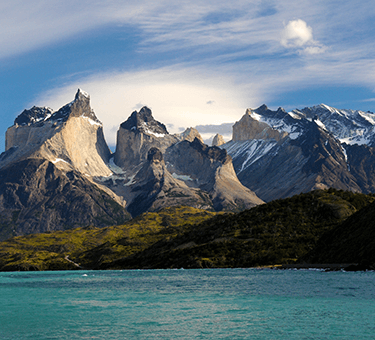
© 2026 Reserva Las Torres
LAWRENCE – I translated a nonfiction book from Chile that is set in a national park, Puma concolor, which is forthcoming this autumn from Eerdmans. It's written by René Araneda, who is a documentary filmmaker and illustrated by Julio Antonio Blasco, and follows a family of wild pumas who lives in the Torres del Paine National Park in Patagonia... mostly in Chile although as wild animals they don't believe in national borders and sometimes their hunting range crosses over into Argentina, too. Working on that book felt like I had a chance to visit that park, even though it is on the other side of the world from me, and to experience even if second hand the wonder of seeing those wild and majestic creatures.
Thank you, Núria and Lawrence, for stopping by and sharing with us. It was wonderful to chat with you both.
Be sure to back Friday for the Perfect Picture Book #PPBF review of The Visit.
To learn more about Núria Figueras or contact her:
Website: https://nuriafigueras.com/
To learn more about Lawrence Schimel or contact him:
Instagram: https://www.instagram.com/lawrence_schimel/


In this day and age of Google Translate and other automated tools, I love this reminder that translating language is more nuanced and complex than simply swapping one word out for another. Congrats to you both on a lovely project!