
The Picture Book Buzz - May 2026 Interview with STEAM Team Books Members (Part 1)
Whether you're here to support the STEAM Team authors, curiosity, or because you love nonfiction books, I hope you read to the end because you'll discover some amazing authors and super spectacular books!

Today I have the pleasure to introduce you to four authors from the STEAM Team Books – a group of authors and illustrators who joined together to celebrate and help promote their STEAM books. I hope you enjoy this peek at these delightful books and fascinating creatives.
"STEAM Team Books is a group of authors who have a STEM/STEAM book releasing in 2026. It includes fiction & nonfiction, trade or educational books.” Check out their website for other interviews, activities, and bios.
Welcome everyone,
Tell us a little about yourself. (Where/when do you write? How long have you been writing? What is your favorite type of book to write? What drew you to STEAM books? etc.)

Curtis Manley – Chasing Eruptions: How Volcanologists Maurice and Katia Krafft Helped Save 60,000 Lives—But Lost Their Own (Clarion/Harper Collins 4/21/2026) – I’ve been writing poetry since high school and took writing classes with some well-known poets in college and grad school. Once my daughter was born and we began reading picture books to her, I began thinking of stories for children. I published some articles in kids’ science magazines, but my first book wasn’t published until about 10 years after I got serious and started a critique group. I’ve always been interested in nature and science, majored in geology in college, and spent time in the tech industry, so with that background I enjoy writing about whatever I find fascinating in the area of STEAM.
[Author of 8 books, including Grace Builds an Almost-Perfect Dog, illustrated by Tracy Subisak (2025), Climbing the Volcano: A Journey in Haiku, illustrated by Jennifer K. Mann (2024), The Rescuer of Tiny Creatures, illustrated by Lucy Ruth Cummins (2021), Just Right: Searching for the Goldilocks Planet, illustrated by Jessica Lanan (2019), The Crane Girl, illustrated by Lin Wang (2017), Shawn Loves Sharks, illustrated by Tracy Subisak (2017), and The Summer Nick Taught His Cats to Read, illustrated by Kate Berube (2016).]

Katie Furze – Kekeno: Curious Explorer (Scholastic NZ 5/1/2026) – My writing journey began fourteen years ago when I had a little time on my hands. My older children were at school and my youngest was at morning kindergarten – it was the perfect opportunity to try something new. I’ve always loved children’s books, especially ones that stimulate the imagination, so I started to write, and I haven’t looked back!
Even if it is just a sentence or two jotted in my journal, I write every day, wherever I am. I like to process my thoughts, ideas and first drafts the old-fashioned way with a pen on paper. I write nonfiction and fiction for children of all ages including picture books, short stories, articles, novels, poems, plays, and early readers and sometimes I write for grown-ups too.
More recently I’ve focused on nonfiction which I absolutely love because of the research and the constraint of sticking to the facts.
[Author of Pekapeka, Secret Forest Bat (2025), Ruru, Night Hunter (2024) and Tuatara, a Living Treasure (2023), all illustrated by Ned Barraud.]

Michelle Schaub - A Pathway for Pollinators (Norton Young Readers 5/5/2026) - I write for toddlers through upper elementary students. I’ve been writing for over twenty-five years, and my first published works were nonfiction articles for children’s magazines like Highlights and Appleseeds. I have a passion for poetry and a fascination with nature and science. I love using wordplay and the sounds and rhythms of language to delight, inspire, and empower kids, especially when it comes to caring for the Earth and its residents.
[Author of 9 books, including Meadows of the Sea: The Wonders of Seagrass, illustrated by Khoa Le (2026), A Place For Rain, illustrated by Blanca Gómez (2024), Leafy Landmarks, Travels with Trees, illustrated by Anne Lambelet (2024) Kindness is a Kite String: The Uplifting Power of Empathy, illustrated by Claire LaForte (2021), Dream Big, Little Scientists: A Bedtime Book, illustrated by Alice Potter (2020), Fresh-Picked Poetry: A Day At The Farmers' Market, illustrated by Amy Huntington (2020), and Finding Treasure: A Collection of Collections, illustrated by Carmen Saldana (2019).]

Kaitlyn Wells – Under the Clam Moon (Macmillan/Roaring Brook Press 5/12/2026) – I've been honing my craft — as an author, tech and service journalist, and writer — my entire career. But I didn’t get serious about writing children’s books until 2019 and sold my first picture book within a year.
I’m still early in my author career so I don’t have a favorite type of book to write yet. But I hope to always write something that surprises and excites little readers. I like to explore language, encourage creativity, and spark imagination with my writing.
Yet, this process hasn’t been easy. Juggling a full-time job and personal responsibilities means sometimes my publishing path becomes a winding road. But I keep working at it to try and deliver on my aim to have children to see themselves represented in the books that they read. I’ve worked really hard to write books that resonate with little readers and their parents. I don’t take this opportunity, this responsibility, for granted.
[Author of A Family Looks Like Love, illustrated by Sawyer Cloud (2022).]
What has been the most interesting or odd experience (you’re willing to share) of your children’s literature career so far?
Curtis Manley – When I climbed South Sister volcano in 2022, Jennifer K. Mann had just started work on the illustrations for my picture book about the mountain, Climbing the Volcano: A Journey in Haiku. She had decided the family she’d illustrate for the story would be a dad, a mom, a child around 7 or 8 years old, and a baby sibling in a backpack carrier. And when I reached the summit, there was a family exactly like that! And that very day was their baby’s first birthday!
Katie Furze – For me, the most interesting experience is speaking with groups of children about my books. Every visit is different. I’m constantly amazed by the connections kids make and the insightful questions they ask. For instance, after I read my book RURU, Night Hunter, I shared how as a child I heard the distinctive call of a ruru (native owl of New Zealand) and wondered what was making that strange sound. One of the kids said, “Oh, so the child in the book is really you?” I hadn’t thought of it this way, but he was quite right – kids are so smart! I’ve also been asked some extremely tricky questions, such as: “How did tuatara survive the asteroid collision that wiped out the dinosaurs?” and “Can lizards and tuatara communicate with each other? I’m mostly looking forward to sharing my new book, KEKENO, Curious Explorer with school groups.
Michelle Schaub – Before I wrote a Pathway for Pollinators, I decided to create my own “pit-stop” on a pollinator pathway. Through research, I’d learned the high environmental cost, particularly to pollinators, of maintaining a green grass lawn. So, I decided to tear out my front lawn and replace it with a native, pollinator friendly garden. My husband suggested that we rent a sod cutter to remove the existing grass, but I said, “Naw, let’s do it by hand. How hard can it be?” Three days, two achy backs, and countless blisters later, the grass was gone and the area was ready for native flowers. Two years later, our front yard is a haven for butterflies, bees, and hummingbirds, so the sweat labor was all worth it. But next time, I’ll rent a sod cutter!
Kaitlyn Wells – This is going to feel out of place but honestly, the most challenging part of my career so far has been survival. At first, surviving the industry itself wasn’t easy. But surviving, well, life was something completely unexpected. My career and life were on hold in 2024 when I was hospitalized for a life-threatening disease that sent me into lung and heart failure. I spent nearly 10 months in the Intensive Care Unit hoping against all odds to make it out alive. I was fortunate enough to receive a double lung transplant thanks to a generous soul and the amazing doctors, nurses, and hospital staff who cared for me. Not exactly related to my career but it did show me there are some amazing people in the kidlit industry who will support you no matter what and won’t pressure you to perform on their timeline.
Thanks for sharing these amazing experiences! Now that we know a little more about all of you, what sparked your interest and caused you to write or illustrate this book?

Curtis Manley – Chasing Eruptions: How Volcanologists Maurice and Katia Krafft Helped Save 60,000 Lives—But Lost Their Own (4/21/2026) – As a graduate student in volcanology, I was familiar with the Kraffts and owned several of their books about volcanoes. They died in Japan in 1991, just before the huge Mt. Pinatubo eruption in the Philippines. Years later, I learned why Pinatubo killed only a relatively small number of people. The “why” was Maurice and Katia Krafft. If they’d lived just two more weeks, they would have heard that a project they had finished up just a few months earlier ended up saving tens of thousands of lives... I wanted to tell their story.

Katie Furze – Kekeno: Curious Explorer (5/1/2026) – I’ve always been interested in fur seals. I used to love watching them diving underwater through the glass at our local zoo, twisting, turning, tumbling, deeper and deeper. A few summers ago, I visited one of the largest fur seal colonies on the mainland of New Zealand in full swing. It was busy, noisy and smelly, and I found it absolutely fascinating watching the interactions between the seals. After that, I knew I wanted to learn more about these incredible marine mammals.

Michelle Schaub - A Pathway for Pollinators (5/5/2026) – The idea for A Pathway for Pollinators actually came from my editor at Norton Young Readers, Simon Boughton. Simon and I were discussing backmatter options for my 2024 lyrical nonfiction picture book, A Place for Rain, which is about a classroom that plans and builds a rain garden. A rain garden is a type of green infrastructure, or landscape created to address the needs of wildlife in developed areas. I mentioned the possibility of describing other types of green infrastructures in the backmatter, for example pollinator pathways. Simon got a big smile on his face and said, “You know, pollinator pathways could be its own book.” With that nudge, I turned it into one!

Kaitlyn Wells – Under the Clam Moon (5/12/2026) – The inspiration for Under the Clam Moon began with a flash of a memory of driftwood on the beach. I attended a virtual craft workshop on generating story ideas with the Society of Children’s Book Writers and Illustrators. The session included random word and photo prompts, and an image of a stick fort in the woods caught my eye.
I lived in the suburbs of Seattle, Washington for a decade, where Douglas Firs and Western Red Cedars were the backdrops of my playground. So that image of the stick fort really called to me. From there, my brain made the connection from children playing outdoors to other activities I enjoyed as a kid. I remember hiking in the woods and playing on a nearby beach, which reminded me of clam digging with my friends.
I love all the various ways that inspiration can 'strike.' Is there anything special you want your readers to know about your book?
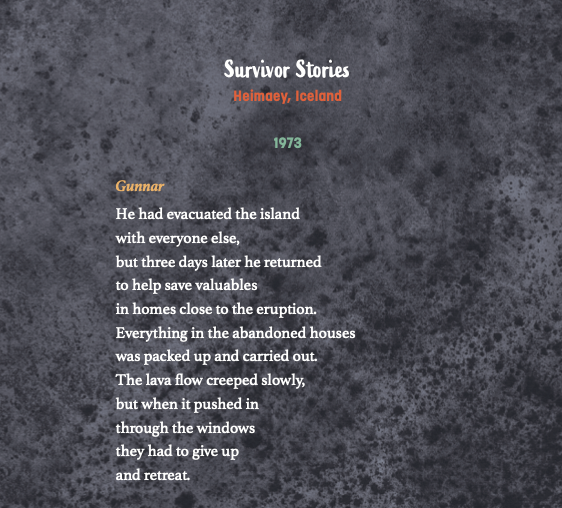
Curtis Manley – Chasing Eruptions: How Volcanologists Maurice and Katia Krafft Helped Save 60,000 Lives—But Lost Their Own (4/21/2026) – The illustrations (by Katherine Roy) and the book design are so wonderfully different from my previous books. Those were all picture books, where every spread has one or more images.

Text © Curtis Manley, 2026. Image © Katherine Roy, 2026.
In Chasing Eruptions, the illustrations are sprinkled through the book, so when a reader encounters the next one it comes as a surprise, a present. Katherine’s images are atmospheric and have just the right touch to illuminate important points in the Kraffts’ lives.
Text © Curtis Manley, 2026. Image © Katherine Roy, 2026.
Katherine also created ashy textures so the pages that tell the stories of eruption survivors have a different feel from the pages of the main narrative, as they should. And the book designers used a range of color to make the locations and dates at the beginning of each section stand out in just the right way.

Text © Katie Furze, 2026. Image © Ned Barraud, 2026.
Katie Furze – Kekeno: Curious Explorer (5/1/2026) – Our book is about the New Zealand fur seal (Arctocephalus forsteri), known as kekeno in Māori. Kekeno can dive deeper and longer than any other fur seal – they can dive up to 300 metres (984 feet) and stay underwater for as long as 10 minutes.

Text © Michelle Schaub, 2026. Image © Blanca Goméz, 2026.
Michelle Schaub - A Pathway for Pollinators (5/5/2026) – A Pathway for Pollinators was written as a companion to A Place for Rain. Both books sing with lyrical language, especially onomatopoeia. And both books are delightfully illustrated by Blanca Goméz. A fun (and educational!) activity to do with young readers is a side-by-side reading of both books to discover similarities (The same six nature-loving kids! The same bright yellow school bus!) and differences (Different environmental missions!)

Text © Kaitlyn Wells, 2026. Image © Mariyah Rahman, 2026.
Kaitlyn Wells – Under the Clam Moon (5/12/2026) – A fun fact I like to share is that I sold this book about a week after I gave birth. It was truly a whirlwind of a time. I’m excited that my baby-baby gets to meet my book baby soon. And he’s been clamoring to go to the beach, so I’ll have the opportunity to teach him how to hunt for clams just like I did as a little girl.
Also, don’t sleep on Mariyah Rahman’s beautiful illustrations. There’s also a surprise guest who makes an appearance throughout the book.
These are all such awesome books! What was the hardest, or most challenging, part of writing or researching your book? Was there a bit of your research you didn’t get to include?
Curtis Manley – Chasing Eruptions: How Volcanologists Maurice and Katia Krafft Helped Save 60,000 Lives—But Lost Their Own (4/21/2026) – I was challenged by almost too many things in the course of this project! Dealing with primary sources in French, German, Icelandic, and Japanese. Needing to write more than 6,000 additional words to convert it from a picture book to a 160-page middle grade nonfiction book. Searching for the stories of survivors of various eruptions from as long ago as 1883. Tracking down pronunciations of words from all over the world to guide the narrator of the audiobook.
And yes, there were many more details I discovered about the lives of Katia and Maurice Krafft that I would have liked to include—but I didn’t want the storyline to become lost. Looking back, I think I really should have added at least a few of those details, but I’m sure I’m not the only author who feels that way about their books!
Katie Furze – Kekeno: Curious Explorer (5/1/2026) – Most of the research for this book was fairly straightforward. However, I found a fascinating scientific paper about half-brain sleeping in fur seals. The research showed that fur seals (and sea-lions) can sleep in the water with half of their brain asleep and the other half awake and alert to breathe and detect predators. I wanted to include this amazing fact in the book if possible, but the study was on northern fur seals – did kekeno do the same thing? Sleep had not been studied in kekeno, so I contacted an expert scientist to find out. The answer was ‘yes’, all fur seals can half-brain sleep in the water – what incredible creatures!
Michelle Schaub - A Pathway for Pollinators (5/5/2026) – Besides the sweat-inducing “hands-on” research of digging out my own green grass lawn to plant a pollinator garden, this project was fairly smooth sailing. Because it was planned as a companion book for A Place for Rain, I already had a blueprint for the book’s structure. I already had completed significant research on green infrastructures and native plants. The most challenging part was reigning in the backmatter. I had SO MANY fascinating details I wanted to include to extend young readers’ learning about different types of pollinators, the co-evolution of specific flowers and pollinators, the importance of pollinators to the world’s food production, etc. But with only two pages to spare, I couldn’t include it all. My editor helped me choose the most salient information. The rest? I added it to my educators’ guide! (Free and downloadable at https://www.michelleschaub.com/guides.)
Kaitlyn Wells – Under the Clam Moon (5/12/2026) – The book is an introduction to one small aspect of the natural world, not an entire reference manual. Synthesizing the amazing breadth of information about all things clams into a couple of spreads of back matter was a challenge. I wanted the information to be engaging and informative without overwhelming young readers, so I stuck to fast facts to pique their interest. I hope it sparks curiosity among those interested in the ocean and encourages them to get their hands dirty in the process.
I think you all did an amazing job with these books and your back matter. Are there any upcoming projects that you are working on now that you can share a tidbit with us?
Curtis Manley – There are a number of book ideas I have lined up to work on, and the one furthest along also involves Earth science—but that’s all I can say…
Katie Furze – I am extremely excited to share that Ned Barraud and I are working on our next book about another very special native animal of Aotearoa New Zealand with Scholastic NZ. Look out for it in 2027!

Michelle Schaub – I have another Norton Young Readers picture book coming out this fall: Pumpkin Smash, illustrated by Rilla Alexander. Pumpkin Smash, also lyrical nonfiction, is about what to do with all those jack-‘o-lanterns after Halloween has passed, when they slouch on their stoops and their smiles start to droop. Throw them away? No way! Take them to a Pumpkin Smash! Pumpkin Smashes are country-wide planned community events where you can hit pumpkins with baseball bats, drop them from tall heights, even launch them from slings. All with the goal of squashing those rotting squash into pulpy bits to add to compost bins. And keep them from clogging up landfills!

Kaitlyn Wells – Yes! I’m in love with Under the Clam Moon but I also have another title coming out at the end of the year: the National Geographic Kids Encyclopedia of African American History and Culture. It’s 304 pages of the exploration of more than 400 years of African American history through photos, maps, artifacts, stories, and more. As lead author, I had the opportunity to work with some amazing Black curators, historians, and expert advisors to produce a one-of-a-kind, comprehensive book about the Black diaspora. This was a beast of a project and I’m excited to welcome it into the world.
They all sound intriguing. We will definitely have to keep our eyes open for these books. Good luck to you all on your projects. Last question, who is your STEAM hero or heroine, living or dead (scientist, naturalist, author, teacher, etc.)? Why?
Curtis Manley – I could name many people, each for a different reason, but I’ll choose Charles Darwin. He signed on to a very long ocean voyage with no true guarantee he would ever return home. His careful observations were groundbreaking on their own, but then he worked through the consequences of what he had observed. He knew what he’d seen and measured, and over many years he became more and more certain he knew what it meant, even though it seemed to go against what he—and nearly everyone in the world—had been taught to believe.
Katie Furze – I can’t answer that with just one name. My STEAM heroes are all the dedicated scientists around the world who work so hard on their research, because it is through knowledge and understanding that we can save species and restore ecosystems. Citizen scientists also have an important part to play and many ordinary people are heroes too.
Michelle Schaub – My STEAM hero, when it comes to caring for pollinators, is Kaitlin Haase, who graciously served as the expert reviewer for A Pathway for Pollinators. Kaitlin is the Southwest Pollinator Conservation Specialist with the Xerces Society. In that role, Kaitlin works closely with urban land managers to help them create healthy green spaces where pollinators can thrive.
Kaitlyn Wells – One STEAM hero/ine I’ve been thinking a lot about these last few years is Dr. Kizzmekia Corbett-Helaire. If her name sounds familiar, that's for good reason. She’s the viral immunologist who led the team at the National Institutes of Health and developed the Moderna COVID-19 vaccine. Thanks to the work that she, her team, NIH Director Dr. Anthony Fauci, the trial participants, and so many others in her corner, we now have a way to fight a disease that’s claimed more than 7 million lives, per the World Health Organization.
And a second person I’ll never want to forget is the one who saved my life and brought me back to my family: my lung donor. Without my donor, I wouldn’t be able to share Under the Clam Moon with all of you, and, most importantly, with my son.
NOW, let me take a moment to introduce you to these amazing STEAM books!
Chasing Eruptions: How Volcanologists Maurice and Katia Krafft Helped Save 60,000 Lives—But Lost Their Own by Curtis Manley, illustrated by Katherine Roy (Clarion/Harper Collins 4/21/2026) – This spectacularly engaging nonfiction middle grade biography is lyrically written in free verse. Beginning with their final day, this first poem sets the format with a header ("The Last Day/ Mount Unzen, Japan/ June 3, 1991, 4:08 p.m.") of title, location, and date. Allowing the reader to individually follow Katia and Maurice as youngsters fascinated with volcanos until they met, married, and embarked on their amazing adventure to study and photograph volcanoes. The stunning, scattered black & white illustrations all contain a fun splash of red (a sweater & skirt, caps, or exploding lava) and a few chosen orange spots. Sidebars offer information on history, terminology, and other scientists (such as Harry Glicken, who guided the Kraffts at Mount St. Helens) and "Survivor Stories" sections profile stories of people who survived volcanic eruptions from 1883 to 1985. The final poems include a wrap back to the opening and a tribute to their discoveries and movies which saved lives and changed scientific knowledge of volcanoes. Phenomenal back matter includes great photographs, an author's note, and information on types of volcanoes, their explosions, and current methods of studying them.
Synopsis: The gripping story of volcanologists Maurice and Katia Krafft, perfect for armchair adventurers who loved The Mona Lisa Vanishes and Becoming Muhammad Ali. Complete with stunning illustrations from award-winning illustrator, Katherine Roy, and extensive backmatter for school and at-home conversations.
This beautiful biography in verse is about two French scientists who changed what we know about volcanoes. Katia, a curious girl who collected pebbles and dreamed of escaping her small town, grew up just a few miles away from Maurice, a boy who knew more about rocks and minerals than his own teachers. . . . When Katia and Maurice met as college students, they formed The Vulcan Team—named after the Roman god of fire—to observe, investigate, and document one of the most dangerous, natural phenomena on the planet: volcanoes!
With dynamic art from award-winning artist Katherine Roy, Chasing Eruptions traces the legacy of Katia and Maurice Kraffts’ volcanic photographs and films—and how their footage continues to inspire and educate today.
Kekeno: Curious Explorer by Katie Furze, illustrated by Ned Barraud (Scholastic NZ 5/1/2026) – A fun nonfiction picture book exploring the first year of a fur seal, exploring its development, dangers, and discoveries. Beautiful illustrations take the reader through the rocky and watery world of the fur seals. As well as a quick look at the dangers of their interactions with humans. In addition to succinct sidebars on each spread, the back matter offers a glimpse of the history of fur seals, "fur seal facts," and a few cautions about encountering them in the wild. It's a gorgeous introduction to the New Zealand fur seal.
Synopsis: Baby Kekeno sniffs the salty air, shakes his flippers and looks around. The waves CRASH onto the rocks. Hold on tight, little fur seal, your mother will be back soon! Meet KEKENO —native New Zealand fur seal— curious EXPLORER, sleek swimmer and deep ocean diver
A Pathway for Pollinators by Michelle Schaub, illustrated by Blanca Gómez (Norton Young Readers 5/5/2026) - Following a class trip to a meadow, where six kids observe various pollinators, their return to a stark, manicured, "steel and stone" of the city causes the kids to ask if they can do something to help pollinators. Bright, colorful illustrations follow the kids' creation of a plan to engage others throughout the city and make a pollinator pathway connecting the city back to the meadow and helping day and night pollinators. A wonderful book with resources to help readers understand the benefits of pollinators and how to create their own pathways.
Synopsis: This bright, read-aloud companion to A Place for Rain inspires readers to build city gardens that connect and support pollinators.
Flitter. Flutter. Buzz. Hum. Come watch a meadow thrum.
But what happens when a meadow meets a metropolis? There’s not much pollen to be found with steel buildings, concrete roads, and primly trimmed lawns. So this classroom plans and builds urban gardens to create an inviting pathway for pollinators to visit.
With lively, lyrical language and beguiling illustrations, A Pathway for Pollinators provides an upbeat and actionable approach to an important environmental issue, empowering readers with the tools to create a habitat for wildlife, grow healthy plants, and support local ecosystems.
Under the Clam Moon by Kaitlyn Wells, illustrated by Mariyah Rahman (Macmillan/Roaring Brook Press 5/12/2026) – A delightful family-centered tale of a girl and her uncle clam hunting under a full moon. With a wonderful colloquial voice, the child guides the reader in looking for clam holes (donuts) and working to reach the clams hiding far under the sand. The startling discovery of a ghost shrimp, uncle's practical joke, and a yummy s'mores bonfire add moments of humor and companionship. Illustrated back matter provides a 'roll call' of different clams, the shapes they make in the sand, and the author's memories of clam hunting as a child. It's a spectacular tribute to families and the marvels of the beach at night.
Synopsis: Guided by moonlight, a child and their uncle travel across a shimmering beach in search of clams...
Big and small, old and young, clams burrow beneath the sand, just waiting to be discovered.
This effervescent tale is a beautiful shoreside journey about creating core family memories, and the wonders of the natural world, perfect for fans of A Different Pond and Owl Moon.
Thank you all for giving us a little peek into yourself and your new books. Wishing you all enormous success with you upcoming projects.
Curtis Manley - Chasing Eruptions: How Volcanologists Maurice and Katia Krafft Helped Save 60,000 Lives—But Lost Their Own (Clarion/Harper Collins 4/21/2026) –
Website: https://curtismanley.com/
Katie Furze – Kekeno: Curious Explorer (Scholastic NZ 5/1/2026) –
Website: https://www.katiefurze.com/
Instagram: https://www.instagram.com/katiefurzeauthor/
Twitter: https://twitter.com/KatieFurze
Michelle Schaub - A Pathway for Pollinators (Norton Young Readers 5/5/2026) -
Website: http://www.michelleschaub.com/
Twitter: https://twitter.com/Schaubwrites
Pinterest: https://www.pinterest.com/MichelleBSchaub/
Kaitlyn Wells – Under the Clam Moon (Macmillan/Roaring Brook Press 5/12/2026) –
Website: https://kaitwells.com/
Facebook: https://www.facebook.com/KaitWells
X (Twitter): https://x.com/KaitWells
Instagram: https://www.instagram.com/kaitwells15
Threads: https://www.threads.net/@kaitwells15
Newsletter: https://substack.com/@kaitwells


Comments